
Regrowing Teeth: The Future of Regenerative Dentistry
Key Takeaways
- Regenerative dentistry seeks to repair or regenerate teeth and other oral tissues using stem cells, tissue engineering, and advanced biomaterials.
- Researchers are exploring tooth regeneration through stem cell therapies, bioengineered teeth, regenerative endodontics, and medications that stimulate natural tooth growth.
- Several regenerative technologies are showing promise in early clinical studies, although further research is needed before widespread clinical use.
- While complete tooth regrowth is not yet a clinical reality, advances in regenerative dentistry could expand future treatment options alongside conventional dental care.
Introduction
The human tooth is designed to function for a lifetime. Typically, humans develop two sets of teeth: Deciduous teeth, known as baby teeth, which begin to fall out around 6 years of age, and are gradually replaced by a permanent set, or adult teeth, by the age of 13-14 years. However, if a permanent tooth is lost due to decay, injury, or gum disease, it does not grow back. The human body cannot form a third set of teeth, which explains why tooth loss is so common. Research suggests that gum disease, one of the leading causes of tooth loss, affects around 20–50% of people worldwide. Tooth loss is especially prevalent among older adults and can significantly affect their health, appearance, confidence, and overall quality of life.
For many years, dentistry has treated tooth loss using artificial solutions such as dentures, bridges, and dental implants. These treatments are effective and widely used, but they only replace the missing tooth. Currently, scientists are developing innovative methods using stem cells, tissue engineering, and genetics to grow real, living teeth. This shift from artificial tooth replacement to natural tooth regeneration has the potential to completely transform the future of dental care.
Understanding Regenerative Dentistry
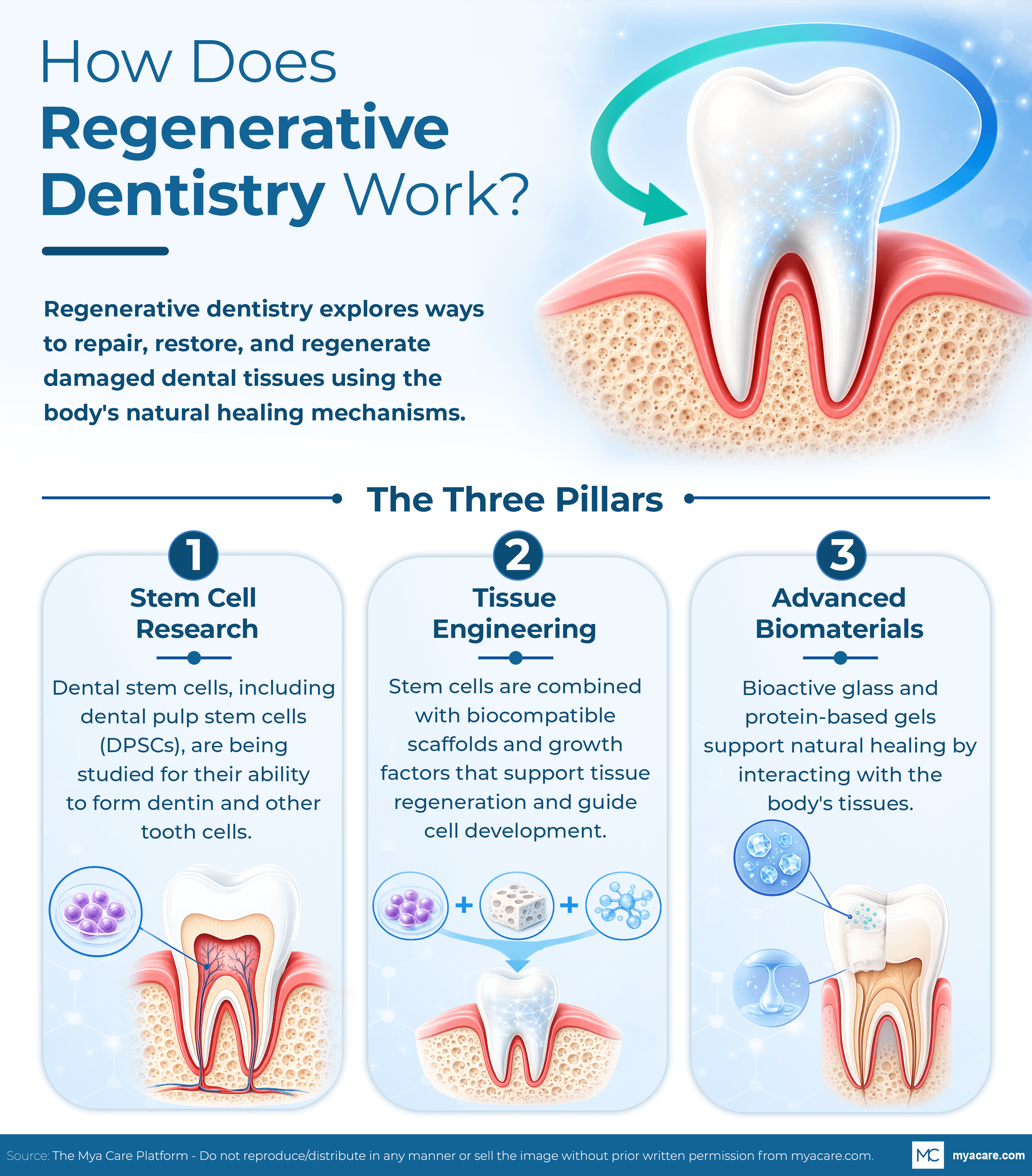
Regenerative dentistry is a field of science that focuses on repairing or regrowing damaged oral tissues such as teeth, bone, gums, and dental pulp. Instead of filling gaps with artificial materials, its main goal is to help the body heal itself using natural biological processes supported by scientific techniques. The aim is to restore the original structure and function of teeth rather than just covering the damage.
The field is based on three main pillars:
-
Stem Cell Research
Scientists study dental stem cells, such as dental pulp stem cells (DPSCs), which can turn into dentin-forming cells and other tooth-related cell types.
-
Tissue Engineering
Stem cells are combined with safe scaffold materials that give shape and support to new tissue growth. This scaffolding is accompanied by growth factors that guide how the cells behave.
-
Advanced Biomaterials
New materials like bioactive glass and protein-based gels are designed to interact with the body and encourage natural healing.
Regenerative dentistry is expanding the range of treatment possibilities in dentistry. A regrown tooth would be alive and responsive, unlike a dental implant. It could attach naturally to the jawbone through the periodontal ligament, allowing slight movement and natural sensation. It could also respond to damage by forming new dentin. This would mark a shift from replacement dentistry to true biological repair.
Teeth Regrowth: A Breakthrough Idea
To understand tooth regrowth, it helps to look at how teeth naturally develop. Every tooth begins as a tooth bud, which is made up of special cells. Guided by genetic signals, these cells slowly develop into enamel, dentin, pulp, and roots.
The most important scientific point is that although the blueprint of a third set of teeth is not found in humans, the genetic and cellular potential can be dormant. Some animals, such as mice, have unused tooth buds that never fully develop. Researchers have hypothesized that humans may retain similar latent pathways for tooth formation. The challenge is to precisely reactivate these pathways to instruct the body to initiate a new round of odontogenesis (scientific term for tooth formation) in the correct location, size, and shape.
Scientists are targeting many important biological mechanisms:
-
Reawakening Epithelial Stem Cells
Identifying and stimulating epithelial remnants in the oral mucosa (like the dental lamina) to form new enamel organs.
-
Modifying Key Signaling Pathways
Manipulating signaling pathways such as Wnt, BMP (Bone Morphogenetic Protein), and FGF (Fibroblast Growth Factor) that are important for tooth patterning and growth.
-
Inhibiting Natural "Brakes" on Growth
Reducing the effect of proteins that stop tooth growth after adult teeth have formed.
A tooth is a highly complex structure made up of multiple specialized layers, nerves, and blood vessels. Recreating these intricate tissues while ensuring the regrown tooth develops a functional blood supply and nerve connections remains a major challenge. Scientists must better understand the processes that guide early tooth development and determine how to adapt them to the adult oral environment.
Latest Research and News
Tooth regrowth is no longer just a theory. Many research teams around the world are now testing it in laboratories and early clinical trials.
Medicine Capable of Regrowing a Third Set of Teeth
One of the most clinically advanced approaches originates from Japan. A research team led by Dr. Katsu Takahashi studied a protein called USAG-1, which blocks tooth growth signals. By stopping this protein, scientists hoped to allow new teeth to form.
In 2018, studies on mice showed promising results. A single dose of a special antibody that blocks USAG-1 helped mice grow fully formed and functional new teeth. These mice had tooth agenesis, which means they were born without some teeth. This study demonstrated that tooth regrowth is biologically possible. Because of this success, the research has moved to human testing. Between 2024 and 2025, a Phase I clinical trial of the anti-USAG-1 drug began in Japan to evaluate its safety in adults. Subsequent trials are testing the safety and effectiveness of the drug in children aged 2 to 7 who have anodontia or oligodontia, meaning they are missing many permanent teeth. If these trials continue to show positive results, researchers believe the treatment could be approved and available for wider use by 2030.
Stem-Cell and Organoid Approaches
-
Dental pulp stem cells (DPSCs)
DPSCs are taken from extracted wisdom teeth or baby teeth. These stem cells are known to multiply and turn into different types of cells. In regenerative dentistry, DPSCs are mainly used to repair the pulp and dentin inside teeth. When placed into the tooth with the right support materials and growth signals, DPSCs can form living tissue with blood vessels and nerves. They can also produce new dentin, which is the hard layer beneath the enamel.
-
Organoid technology
Instead of using loose cells, scientists are now growing three-dimensional mini tooth models called organoids in laboratories. Researchers have combined different dental cells to form these organoids. These structures can copy the early stages of tooth development. They can activate important tooth-forming genes and even start forming minerals like real teeth.8 These organoids are useful for studying how teeth grow and for testing new treatments.
-
Bioengineered teeth in animal models
Proof-of-concept studies have shown the feasibility of growing whole teeth. In one approach, researchers have created a "bioengineered tooth germ" by seeding a degradable scaffold with dental epithelial and mesenchymal cells. When this structure is implanted into the jawbone of animals such as mice or mini-pigs, it grows into a complete tooth. The tooth develops a proper crown and root, erupts into the mouth, and aligns with other teeth for normal chewing.
Regenerative Endodontics
This area of dentistry focuses on saving the natural life (vitality) of a damaged and immature permanent tooth. The process is often called a "revascularization" or "regeneration" protocol. During the procedure, the dentist first cleans the infected tooth and then induces slight bleeding within the root. This bleeding brings the patient’s own stem cells into the area. The tooth is then sealed with a special material like mineral trioxide aggregate (MTA). This helps new tissue and blood vessels form inside the tooth, allowing the root to continue growing normally. The new tissue may not be exactly the same as natural pulp, but it works better than traditional root canal fillings.
Lab-Grown and 3D Bioprinting Possibilities
-
Lab-grown teeth
A team at King's College London is figuring out how to grow teeth in a lab.11 Their breakthrough was creating a special gel that slowly sends "grow here" signals to cells just like what happens in the body. This slow signal lets the cells communicate properly and start turning into different parts of a tooth. This was a problem that stopped earlier experiments. The goal is to either put these very young tooth cells into a patient's jaw to grow or to build a whole tooth in the lab first and then implant it.
-
3D/bioengineering advances
Bioprinting allows scientists to print tooth structures using special bio-inks filled with dental stem cells. This makes it possible to create teeth that match a patient’s exact shape and size. Researchers are also exploring unusual sources of stem cells. For example, stem cells taken from urine have been turned into tooth-like structures in animals. This shows a creative way to use a patient’s own cells for tooth repair.
Gel That Can Regrow Enamel
Regrowing the hard outer layer of teeth (enamel) has always been a huge challenge because it is not living tissue. However, scientists have made a new protein-based fluoride-free gel that copies the body's own process for building enamel. When this gel is applied to a damaged tooth, it pulls minerals from saliva and rebuilds them into a strong enamel layer. The new enamel bonds tightly to the old one. In laboratory tests, the gel repaired worn enamel and reduced tooth sensitivity. A startup company has been created to bring this technology to the market, with a possible product expected around 2026–2027.
Innovative Materials for Tooth Repair and Regeneration
-
Advanced hydrogels for repair:
Scientists are creating "smart" hydrogels that can be injected into a cavity. Once inside the tooth, these gels harden and slowly release minerals such as calcium, phosphate, and fluoride. They can also release growth signals that encourage the tooth’s own cells to produce new dentin. This allows the cavity to heal from the inside instead of just being filled.
-
Bioactive glass in dentistry:
These materials can attach to bone and help it grow back by stimulating natural bone formation. Dentists already use these materials to repair bone around teeth. New versions are being developed to also support tooth-forming cells. This makes them promising for treatments that repair both tooth structure and surrounding bone.
Benefits of Tooth Regrowth Therapies
The successful clinical translation of tooth regrowth can offer several advantages. These include:
-
True Biological Integration
A regenerated tooth with a living periodontal ligament would function as a natural organ. It would maintain the health of the jawbone and prevent resorption common under dentures, provide natural proprioceptive feedback, and adapt to changes in the mouth over a lifetime.
-
Superior Longevity and Health
Unlike the artificial implants that have a finite lifespan and risk of peri-implantitis, a living tooth could theoretically last a lifetime and possess innate repair mechanisms.
-
Elimination of Rejection Risks
Autologous therapy with the patient's own cells or induction of their own regenerative pathways, such as the anti-USAG-1 drug, eliminates the immune rejection issues associated with donor tissues or even certain biomaterials.
-
Paradigm Shift in Pediatric Care
In the case of children born with genetic tooth agenesis, regenerative therapies could offer a non-prosthetic treatment option. It is an expanding solution that grows with them, which does not involve complicated serial replacements necessary with the existing pediatric dentistry.
Limitations and Ethical Considerations
Despite the exciting progress, there are certain challenges that remain between the laboratory success and routine dental practice:
-
Biological Complexity
The ability to regulate the size, shape, and accurate occlusal alignment of a regrown tooth in three dimensions is challenging. Proper positional identity, such as incisor vs. molar, is also complicated.
-
Timeline and Cost
The path from Phase I trials to approved therapy is long, expensive, and uncertain. Even after approval, advanced cell-based therapies may initially be prohibitively costly. This raises concerns about equitable access.
-
Safety and Regulation
Long-term safety data is absent. For stem cell-based approaches, risks include tumorigenicity (teratoma formation), improper differentiation, or unintended systemic effects. The regulatory bodies, like the FDA and EMA, will require rigorous evidence.
-
Ethical Questions
Although the use of adult DPSCs is not a controversial issue, the methods that may utilize or produce human embryonic stem cell lines or those that may involve germline genetic alterations are viewed as controversial. The sourcing of biological materials must be transparent and consensual.
What This Means for the Future of Dentistry
Research in dental regeneration is advancing rapidly and has the potential to reshape aspects of dental care. For more than a century, dentistry has largely relied on mechanical approaches, such as removing damaged tooth tissue, filling cavities, and replacing missing teeth with prosthetics or implants. Regenerative dentistry aims to complement these methods by encouraging the body's natural ability to repair or regenerate dental tissues.
Although many of these approaches remain under investigation, future treatments may include regenerative materials to repair early enamel damage, engineered dental pulp to restore the inner tooth after injury or infection, and therapies that stimulate the growth of new teeth in selected cases. As these technologies continue to develop, dental practice could increasingly incorporate biologically based therapies alongside conventional treatments.
The ability to reliably regenerate a complete adult tooth is still some way from clinical reality. However, ongoing advances in enamel repair, pulp regeneration, and whole-tooth bioengineering are improving our understanding of what may be possible in the future. While further research and clinical testing are needed, these developments could expand treatment options and move regenerative therapies closer to routine clinical practice.
To search for the best Dentists and Dentistry Providers in India, Malaysia, Singapore, Spain, Thailand, Turkey, the UAE, the UK, and the USA, please use the Mya Care search engine.
To search for the best doctors and healthcare providers worldwide, please use the Mya Care search engine.

Dr. Shilpy Bhandari is an experienced dental surgeon, with specialization in periodontics and implantology. She received her graduate and postgraduate education from Rajiv Gandhi University of Health Sciences in India. Besides her private practice, she enjoys writing on medical topics. She is also interested in evidence-based academic writing and has published several articles in international journals.
References:
Featured Blogs

Medically Induced Coma: What It Is, How It Works, Who Benefits, and Recovery Outcomes