
Hypertrichosis (Excessive Hair Growth): Causes, Types & Treatment
Medically Reviewed by Dr. Sony Sherpa, (MBBS) - September 01, 2026
Fact Checked and Edited by Abinaya Muralidharan, M. Pharm - September 01, 2026
Key Takeaways
- Hypertrichosis causes excessive hair growth on the face or body and may be congenital or develop later due to medications, medical conditions, or other factors.
- The condition includes several subtypes based on onset, extent, and hair type and should be distinguished from androgen-driven hirsutism.
- Diagnosis may involve examining hair growth patterns, reviewing family and medication history, and performing hormone or genetic testing when appropriate.
- Management focuses on hair removal and addressing underlying causes; acquired forms may improve when the trigger is treated or removed.
- Emotional support can help address the psychological and social impact of hypertrichosis.
Introduction
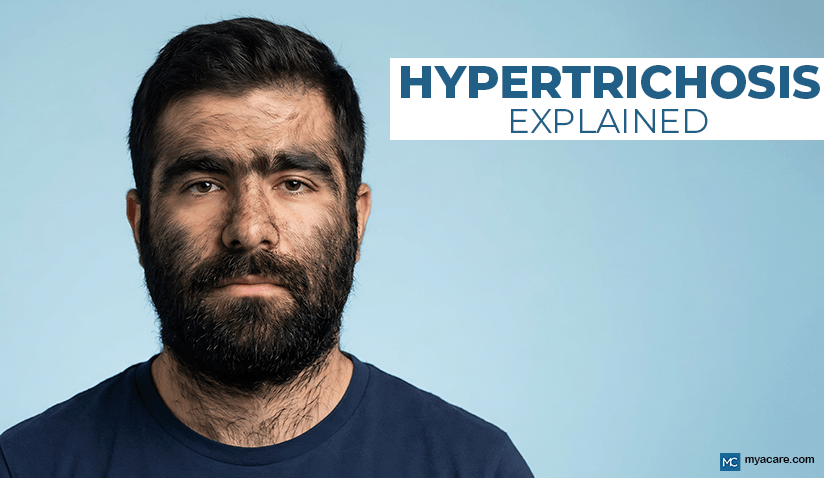
Hypertrichosis, often informally referred to as “werewolf syndrome” or “Chewbacca syndrome,” is a rare condition defined by excessive hair growth on the body and face. The term comes from the Greek words “hyper” (excessive) and “trichos” (hair). Depending on the type, this unusual hair growth can either be present from birth (congenital hypertrichosis) or develop later in life (acquired hypertrichosis).
Congenital hypertrichosis is uncommon, with only a few 100 documented cases worldwide. The acquired form occurs more frequently than the congenital type, though it likely goes underdiagnosed and underreported in practice. Hair growth can vary widely in both amount and pattern, ranging from fine, light hair on limited areas to dense, thick hair covering most of the body – sometimes giving individuals a striking resemblance to mythical werewolves.
In recent years, hypertrichosis has received wider public attention through the story of Lalit Patidar from India. Having lived with extensive hair growth across his face and body since childhood, he has publicly shared his experiences and the challenges associated with the condition.
What Is Hypertrichosis?
Hypertrichosis is a medical term used to describe excessive hair growth that occurs anywhere on the body, regardless of gender, age, or ethnicity. This hair growth can be vellus (fine and soft) or terminal (thick and coarse) and may appear in areas that normally do not have much hair. The condition can affect a small patch of skin or spread over large areas, including the face, arms, or torso.
From a clinical perspective, hypertrichosis differs from the normal variation in body hair caused by hormonal changes or ethnicity; it is considered abnormal hair growth not driven by androgen hormones.
It is important to distinguish hypertrichosis from hypotrichosis.
- Hypertrichosis: Excessive hair growth beyond the typical amount.
- Hypotrichosis: Decreased hair growth or sparse hair in areas where hair would normally grow.
In short, while hypertrichosis results in too much hair, hypotrichosis leads to too little.
What Are the Risk Factors and Causes of Hypertrichosis?
Hypertrichosis can arise from a range of factors – genetic, drug-induced, or secondary to medical and dermatological conditions. In some cases, the cause remains unknown, making diagnosis and treatment more complex.
Genetic Mutations
Certain forms of hypertrichosis are congenital, meaning they are present from birth due to genetic mutations that affect hair follicle development or regulation.
Rare syndromes such as Ambras syndrome and Barber-Say syndrome are associated with congenital hypertrichosis.
- Ambras syndrome involves extensive hair growth over the face and body, often linked to chromosome 8 abnormalities.
- Barber-Say syndrome features generalized hypertrichosis along with distinctive facial and skin abnormalities.
Can females inherit hypertrichosis?
One well-studied form, congenital generalized hypertrichosis, is inherited in an X-linked dominant pattern – this means the gene responsible is located on the X chromosome. Because males have only one X chromosome, an X-linked genetic change can affect their cells more consistently, while females have two X chromosomes and experience random X-inactivation. As a result, males may show more extensive hair growth if the gene is present, while females can also inherit and express the condition.
The term “holandric gene” is sometimes incorrectly used to describe hypertrichosis inheritance; however, holandric actually refers to Y-linked genes, which are passed from father to son. True Y-linked hypertrichosis is rarely confirmed, and most documented genetic cases are X-linked.
Drug-Induced Causes
Several medications can trigger excessive hair growth as a side effect, known as drug-induced hypertrichosis.
Common examples include:
- Minoxidil, a drug indicated to treat hair loss, can stimulate unwanted hair growth on the face or body when absorbed systemically.
- Cyclosporine, an immunosuppressant often prescribed after organ transplantation, can cause thick hair growth on the eyelashes, face, and limbs.
Other drugs such as phenytoin (used for epilepsy) and corticosteroids can also contribute to the condition.
Underlying Medical Conditions
Acquired hypertrichosis may occur due to systemic diseases or metabolic disturbances. Conditions such as porphyria cutanea tarda, anorexia nervosa, and certain malignancies can trigger excess hair growth.
- In porphyria cutanea tarda, abnormal buildup of porphyrins increases skin sensitivity and can stimulate hair growth on the cheeks and temples.
- In anorexia nervosa, fine hair (lanugo) grows as the body’s adaptive response to retain heat due to significant fat loss.
- PMOS (Polyendocrine Metabolic Ovarian Syndrome; formerly called PCOS) may also cause increased hair growth, though in this case it is hormone-driven (hirsutism) rather than true hypertrichosis.
Dermatological Disorders
Certain skin or inflammatory conditions, such as chronic irritation, localized trauma, or scarring, may stimulate nearby hair follicles, leading to localized hypertrichosis. Examples include post-burn scars, insect bites, or sites of prior cast/plaster application.
Idiopathic Cases
In some individuals, no underlying cause or trigger can be identified. These idiopathic cases remain unexplained, and the precise mechanism is not yet understood.
What Are the Symptoms of Hypertrichosis?
The main symptom of hypertrichosis is excessive hair growth that appears in areas not typically hairy for a person’s age, sex, or ethnicity. The hair can vary in color, texture, and thickness, and may develop gradually or suddenly depending on the cause.
Hypertrichosis symptoms may affect different areas of the body. Commonly affected areas include the face, arms, back, chest, and legs, though in some cases, the entire body may be involved. In facial hypertrichosis, for instance, dense hair may appear on the cheeks, forehead, or upper lip, often resembling a beard-like growth pattern. Auricular hypertrichosis refers to excess hair growth on or around the outer ears. Although this feature was historically linked to the Y chromosome, molecular evidence does not support Y chromosome inheritance.
Other symptoms may be related to the underlying condition. For example, acquired hypertrichosis lanuginosa, which can be associated with certain cancers, may also present with unexplained weight loss. In contrast, hypertrichosis linked to anorexia nervosa or porphyria may coincide with other metabolic or skin-related signs. Visible or extensive hair growth may also contribute to psychological distress.
Types of Hypertrichosis
Hypertrichosis can be classified in several ways, by timing of onset, extent of hair growth, or type of hair involved.
Based on Onset
Congenital hypertrichosis
This form is present from birth and is often due to genetic mutations. The hair growth usually persists throughout life. Subtypes include:
- Congenital generalized hypertrichosis – Excessive hair covers most of the body, sparing only the palms and soles.
- Congenital generalized hypertrichosis terminalis – Involves thick, pigmented terminal hair across the body.
- Congenital hypertrichosis lanuginosa – Characterized by fine, soft lanugo hair that normally disappears before birth but persists after delivery.
- Congenital terminal hypertrichosis – Dense, coarse terminal hair appears in localized or generalized patterns.
- Congenital hypertrichosis universalis – A rare variant involving the ears, nose, face, and shoulders.
Acquired hypertrichosis
This type develops later in life due to underlying medical conditions, medications, or metabolic disturbances. Subtypes include:
- Acquired generalized hypertrichosis – Slow, reversible widespread hair growth often linked to systemic illness or malignancy.
- Acquired localized hypertrichosis – Limited to one area, often due to repeated friction, trauma, or inflammation.
- Acquired hypertrichosis lanuginosa – Characterized by rapid appearance of soft lanugo hair, sometimes as a paraneoplastic sign (warning sign of cancer).
- Localized hypertrichosis with traumatic panniculitis – Hair overgrowth confined to areas of chronic trauma or inflammation under the skin.
Based on Extent
Generalized hypertrichosis
Involves widespread hair growth across multiple body regions. This can be congenital (genetic) or acquired (secondary to disease or drugs).
Localized hypertrichosis
Excessive hair growth confined to a specific part of the body. Common variants include:
- Nevoid hypertrichosis – Hair growth limited to a well-defined patch resembling the pattern of a birthmark.
- Anterior cervical hypertrichosis – Excess hair growth localized to the front of the neck, sometimes linked to mild neurological or musculoskeletal anomalies.
Based on Hair Type
The nature of the hair helps classify the condition further:
-
Lanugo hair
Fine, soft, and unpigmented; normally seen on newborns and shed after birth. Persistence indicates conditions such as congenital or acquired hypertrichosis lanuginosa.
-
Vellus hair
Short, thin, light-colored hair that covers most of the body; may become more prominent in mild hypertrichosis.
-
Terminal hair
Thick, coarse, and pigmented hair typical of the scalp, beard, and pubic areas; excessive growth forms hypertrichosis terminalis.
Other Specific Types
-
Eyelash hypertrichosis (hypertrichosis of eyelashes)
Excessive length, thickness, or curling of the eyelashes, which can occur congenitally or as a side effect of certain drugs (like prostaglandin analogs used for glaucoma).
-
Prepubertal hypertrichosis
Excess body hair in children without elevated circulating hormones (linked to heightened androgen receptor sensitivity), often hereditary and benign.
-
Auricular hypertrichosis
Hair growth on the ears, occasionally inherited through the Y chromosome and more common in men.
Hypertrichosis vs. Hirsutism
Although both hypertrichosis and hirsutism involve excessive hair growth, they differ in cause, pattern, and hormonal influence.
Hypertrichosis refers to an abnormal increase in hair growth that may develop anywhere on the body, including areas not typically influenced by hormones. It can manifest in both males and females and may be either congenital (genetic) or acquired later in life due to medications or medical conditions. Importantly, hypertrichosis is not caused by excess androgens (male hormones) – hormone levels are usually normal.
In contrast, hirsutism specifically affects women and is defined as the growth of thick, pigmented hair in a male-pattern distribution, such as on the chin, chest, abdomen, or upper lip. It is caused by increased androgen production or greater sensitivity of hair follicles to these hormones. Polyendocrine metabolic ovarian syndrome is the most common cause of hirsutism, but it can also occur due to adrenal or ovarian tumors.
In summary, hypertrichosis is non-hormonal and can affect anyone, while hirsutism is hormone-driven and occurs only in females, producing hair in areas typical of male growth patterns. This distinction is key for proper diagnosis and treatment.
Diagnosis and Evaluation of Hypertrichosis
Diagnosing hypertrichosis involves a combination of physical examination, medical history, and laboratory testing to determine the type and possible cause of excessive hair growth. Since the condition can resemble hirsutism, which is hormonally driven, distinguishing between the two is an important part of the evaluation process.
Physical Examination
Evaluation starts with a complete physical assessment. Doctors assess the distribution, density, and texture of the hair – whether it is fine (vellus), soft and downy (lanugo), or coarse and pigmented (terminal). The pattern of hair growth also helps identify the type: localized hypertrichosis may occur over scars or certain skin lesions, while generalized forms cover large parts of the body. The presence of other skin findings, such as scars or a history of skin trauma, can suggest post-traumatic hypertrichosis, whereas nevoid hypertrichosis typically presents without any underlying skin lesion.
Family and Drug History
A detailed family history helps determine if the condition runs in families, as some congenital forms of hypertrichosis are hereditary and may follow an X-linked dominant pattern. Doctors also review the drug history, since several medications are known to cause excessive hair growth. Drugs like minoxidil, cyclosporine, phenytoin, and corticosteroids can induce hair growth that mimics or worsens hypertrichosis. Identifying and discontinuing such medications, under medical supervision, can help manage symptoms.
Hormone and Genetic Testing
Since excessive hair growth in females can suggest hormonal imbalance, hormone testing is often performed to rule out hirsutism and other endocrine disorders such as polyendocrine metabolic ovarian syndrome, Cushing’s syndrome, or congenital adrenal hyperplasia. If androgen (male hormone) levels like testosterone and DHEA-S are normal, the condition is more likely hypertrichosis rather than hirsutism.
In suspected congenital cases, genetic testing may be used to identify mutations or chromosomal changes linked to rare forms such as Ambras syndrome or Barber-Say syndrome.
Treatment and Management of Hypertrichosis
Can Hypertrichosis Be Cured?
Currently, there is no permanent cure for hypertrichosis, especially for congenital forms caused by genetic mutations. However, cosmetic, medical, and supportive treatments can effectively manage the condition by reducing unwanted hair growth and improving quality of life. In acquired hypertrichosis, symptoms may lessen or completely resolve if the underlying cause – such as a medication or medical condition – is identified and treated early. Treatments for hypertrichosis can include:
Hair Removal and Cosmetic Options
The mainstay of hypertrichosis treatment involves cosmetic hair removal techniques, which vary based on the type and extent of hair growth:
-
Shaving and waxing:
Simple and affordable methods for temporary hair removal; however, regrowth occurs within days to weeks.
-
Depilatory creams:
Chemical-based creams that dissolve hair at the skin’s surface, offering smooth results for a short duration.
-
Electrolysis:
A permanent hair removal method that applies electrical currents to destroy hair follicles. It is effective but time-consuming and may cause mild skin irritation.
-
Laser hair removal:
One of the most common long-term solutions. It targets the pigment in hair follicles to reduce regrowth after several sessions. However, results depend on hair color, skin tone, hair growth stage, and treatment plan.
What can cause paradoxical hypertrichosis?
In rare cases, laser hair removal can trigger paradoxical hypertrichosis, where new hair growth appears, or existing hair becomes thicker within the treated area or in areas adjacent to treated zones. This reaction is thought to occur when low-energy laser settings stimulate dormant hair follicles instead of destroying them.
Can paradoxical hypertrichosis be reversed?
Yes, in many cases, it can be improved or controlled by:
- Adjusting laser energy settings under professional guidance.
- Switching to a different laser wavelength suitable for the individual’s hair and skin type, though its clinical efficacy remains under study.
- Avoiding repeated low-fluence treatments that might stimulate rather than suppress follicles.
To reduce the risk of paradoxical hypertrichosis, patients should ensure that laser treatments are performed by qualified dermatologists using appropriate devices calibrated for their skin and hair characteristics.
Medical Management
In certain cases, doctors may prescribe topical or systemic medications to slow down hair growth.
- Topical eflornithine cream can help reduce facial hair growth by blocking enzymes involved in hair production.
- Topical capryloyl glycine cream (over-the-counter ingredient - not an FDA-approved drug for hypertrichosis) can help reduce hair density and growth rate by inhibiting an enzyme (ornithine decarboxylase) involved in hair follicle cell growth.
- Oral bicalutamide (off-label) and oral spironolactone (off-label) block the androgen receptors at the hair follicle and have been used experimentally to counter minoxidil-induced hair growth.
If hypertrichosis is drug-induced, discontinuing or replacing the causative medication often leads to gradual improvement.
Treating the Underlying Condition
When hypertrichosis occurs secondary to another illness – such as porphyria cutanea tarda, anorexia nervosa, or malignancy – treating the primary disease is essential. Once the underlying condition is managed, excess hair growth often subsides on its own.
Prognosis
The prognosis for hypertrichosis largely depends on the cause.
- Congenital hypertrichosis is usually lifelong, but with cosmetic treatments and counseling, individuals can lead healthy, fulfilling lives.
- Acquired forms may be reversible once the triggering factor is removed.
Importantly, hypertrichosis itself is not life-threatening, though it can impact mental health and social well-being if not addressed supportively.
Living With Hypertrichosis
Living with hypertrichosis can be emotionally challenging due to social stigma and self-consciousness about appearance. However, a supportive care plan can make a significant difference.
Day-to-Day Management Tips
- Regular grooming routines such as trimming, waxing, or laser sessions can help manage visible hair and support confidence.
- Gentle skincare before and after hair removal reduces irritation and folliculitis.
- Sun protection is essential after laser sessions to prevent pigmentation changes.
Mental Health and Emotional Support
People with hypertrichosis often experience anxiety, embarrassment, or social isolation due to their appearance. Seeking psychological counseling or joining support groups can help individuals cope and build self-esteem.
Professional and Cosmetic Support
Consulting a dermatologist or cosmetic specialist ensures that hair removal methods are safe and effective for one’s skin type. Supportive measures may also include guidance on makeup techniques or cosmetic treatments to enhance comfort and appearance.
While the condition itself is benign, addressing the emotional impact through therapy, education, and compassionate support is crucial for improving overall well-being.
To search for the best healthcare providers for Dermatology in Croatia, Germany, Malaysia, Singapore, Slovakia, Spain, Thailand, the UAE, the UK, and the US, please use the Mya Care search engine.
To search for the best doctors and healthcare providers worldwide, please use the Mya Care search engine.
The Mya Care Editorial Team comprises medical doctors and qualified professionals with a background in healthcare, dedicated to delivering trustworthy, evidence-based health content.
Our team draws on authoritative sources, including systematic reviews published in top-tier medical journals, the latest academic and professional books by renowned experts, and official guidelines from authoritative global health organizations. This rigorous process ensures every article reflects current medical standards and is regularly updated to include the latest healthcare insights.
Dr. Sony Sherpa completed her MBBS at Guangzhou Medical University, China. She is a resident doctor, researcher, and medical writer who believes in the importance of accessible, quality healthcare for everyone. Her work in the healthcare field is focused on improving the well-being of individuals and communities, ensuring they receive the necessary care and support for a healthy and fulfilling life.

Abinaya Muralidharan holds an M. Pharm in Pharmacology. She specializes in turning complex science into clear, credible content, with experience spanning clinical safety, regulatory affairs, and medical communications. She has worked across various therapeutic areas, including but not limited to oncology, dermatology, hematology, and cardiology. She has authored publications in peer-reviewed journals, including original research papers and review articles.
References:
Featured Blogs

Medically Induced Coma: What It Is, How It Works, Who Benefits, and Recovery Outcomes