
Lichen Planus: Symptoms, Causes, Diagnosis, and Treatment

Medically Reviewed by Dr. Rae Osborn, Ph.D. - July 03, 2026
Lichen planus is a chronic autoimmune condition affecting the skin, mucous membranes, scalp, nails, and genital areas, often causing itchy, inflammatory lesions and discomfort. Potential triggers include medications, viral infections, allergens, and stress. The condition may present in several forms, with management focusing on symptom control through topical or systemic therapies, lifestyle measures, and monitoring for complications such as scarring, pigmentation changes, and rare malignant transformation.
What Is Lichen Planus?
Lichen Planus (LP) is an autoimmune condition that affects the skin, mucous membranes, hair, and nails. It is both chronic and inflammatory. In autoimmune disorders, the body's immune system mistakenly attacks its own healthy cells. In the case of lichen planus, the attack targets the skin and mucosal linings, leading to the characteristic lesions. Lichen planus is not contagious and cannot be spread through physical contact, sharing items, or sexual activity.
The condition has a worldwide prevalence, affecting approximately 0.5% to 4% of the general population. The onset of the disease is most common between the ages of 30 and 60. Women are slightly more likely to develop lichen planus, especially the mucosal forms of the condition.
What Causes Lichen Planus, and What Are the Risk Factors?
The exact causes of lichen planus remain unclear. It is generally believed that a T-cell-mediated autoimmune reaction is responsible, as it damages basal keratinocytes in the skin and mucosa. Several potential triggers and risk factors can initiate or exacerbate this process:
-
Certain Medications
Such as those used to treat hypertension, like beta-blockers, diuretics, and ACE inhibitors, can lead to drug-induced lichenoid reactions. Additionally, antimalarials, NSAIDs, and some antibiotics may produce a similar effect.
-
Viral Infections
May also trigger lichen planus. Notably, an association exists between oral lichen planus, cutaneous lichen planus, and Hepatitis C virus (HCV) infection.
-
Allergens
Particularly, contact allergens, such as certain metals (dental amalgams in dental lichen planus), flavoring agents, or chemicals, can act as triggers, especially for oral lesions.
-
Genetic Predisposition
Genetic predisposition cannot be entirely discounted. A family history of lichen planus, for example, suggests a possible genetic component in some individuals.
-
Stress and Immune Dysfunction
May also be connected. Physical or emotional stress can act as a trigger or exacerbate existing disease. This is believed to happen through complex effects of stress on immune system regulation. Immune dysregulation associated with microbial imbalance may also cause lichen planus.
Classification of Lichen Planus, Affected Organs, and Clinical Manifestations
Lichen planus is classified according to the site involved and the morphology of the lesions. The primary distinction is between cutaneous (skin) and mucosal variants.
Cutaneous Lichen Planus
The classic lichen planus skin rash is characterized by the so-called six Ps (6Ps). The six Ps stand for:
Purple → Polygonal → Planar → Pruritic (intensely itchy) → Papules and Plaques
The 6Ps are often accompanied by Wickham’s striae. The purple (violaceous) hue is present primarily due to a dense band-like lymphocytic infiltrate at the dermal-epidermal junction. Wickham’s striae are a pathognomonic feature – fine, white, lacy lines or dots that can be seen on the surface of the papules. Common sites include the wrists, forearms, ankles, lower back, and shins.
Mucosal Lichen Planus
We can differentiate several types of mucosal lichen planus based on the body area affected.
Here’s an overview:
-
Oral Lichen Planus:
The most common mucosal form of lichen planus; symptoms in the mouth include small white papules, white lacy streaks (reticular lichen planus), or more severe red, atrophic, and ulcerative patches (erosive lichen planus). It most often affects the inner cheeks, gums, palate, and tongue.
-
Genital Lichen Planus:
Can affect women and men. In women, vulvar lichen planus can cause white linear papules, painful erosions, redness, and scarring. In men, it may appear as purple rings on the glans penis.
-
Scalp LP or Lichen Planopilaris:
Causes scalp inflammation, scarring, and permanent hair loss.
-
Nail Lichen Planus:
Leads to nail thinning, ridging, splitting, and, in severe cases, permanent nail loss (pterygium).
Other Variants of Lichen Planus
-
Hypertrophic Lichen Planus:
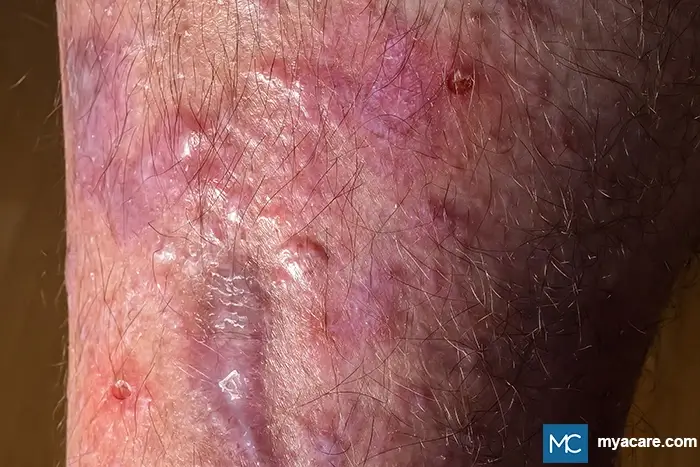
Presents as thick, wart-like, hyperkeratotic plaques, often on the shins.
-
Lichen Planus Pigmentosus:
Causes slate-gray to brownish macules, often on the face and neck or in intertriginous areas (lichen planus pigmentosus inversus).
-
Annular, Linear, and Bullous Lichen Planus:
Form rings (annular), lines (linear, often along lines of trauma), and blisters (bullous, a rare manifestation of lichen planus).
-
Esophageal Lichen Planus:
A rare but serious variant causing dysphagia and risk of strictures.
What Are the Common Questions on the Key Symptoms of Lichen Planus?
Here are the answers to some common key symptom-related questions:
Can lichen planus affect the eyes?
Rarely, it can cause conjunctival scarring.
Is lichen planus always itchy?
Cutaneous lichen planus is typically very pruritic. However, mucosal forms may cause burning or pain rather than itching.
Does lichen planus cause fatigue?
Fatigue is not a direct symptom of the condition but can present in some patients who have depression with lichen planus. Chronic discomfort, pain, and the stress of managing a long-term condition can reduce quality of life and indirectly lead to significant fatigue.
What Are the Potential Complications?
Like most autoimmune disorders, lichen planus is associated with certain complications:
- Post-inflammatory hyperpigmentation in the form of dark spots that linger long after the active rash subsides. This is more common in darker skin tones.
- Scarring forms of lichen planus can lead to permanent nail or hair loss.
- The eroded skin or mucosa is a perfect environment for bacterial growth, potentially leading to secondary bacterial infections.
- There is a small but significant risk (0.44% to 2.15%) of malignant transformation, particularly in erosive and atrophic forms of lichen planus. These may progress to oral squamous cell carcinoma, necessitating regular monitoring.
Diagnosing Lichen Planus
The clinical evaluation of the distinctive lesions is the first step in diagnosing lichen planus. However, a definitive diagnosis requires a biopsy sample for histopathology. For a positive diagnosis, the microscopic examination should include features such as:
- Band-like lymphocytic infiltrate at the dermo-epidermal junction
- Hypergranulosis
- Civatte bodies (dying keratinocytes)
- Interface dermatitis
- Hyperkeratosis
The presence of eosinophils in lichen planus is not typical and may suggest a lichenoid drug eruption. Direct immunofluorescence may show a characteristic “shaggy” fibrin deposition at the basement membrane.
Lichen Planus Differential Diagnosis
Lichen planus can resemble several other conditions, making accurate diagnosis crucial:
- Psoriasis (particularly plaque psoriasis vs. hypertrophic lichen planus).
- Discoid lupus erythematosus: Lichen planus typically does not show the deeper dermal or periadnexal inflammatory changes associated with lupus.
- Oral leukoplakia: a white patch that cannot be scraped off and carries a higher risk of malignancy.
- Lichenoid drug eruption: A drug-induced lichen planus mimic.
- Pemphigus vulgaris may appear similar to some erosive oral forms of lichen planus.
- Lichen Simplex Chronicus (LSC) is caused by chronic scratching, leading to thickened skin, but lacks the polygonal purple papules of lichen planus.
- Lichen sclerosus often causes white, atrophic plaques, commonly in the genital area.
- Lichen nitidus features tiny, flesh-colored, pinpoint papules.
- Oral lichen planus (OLP) affects the oral mucosa. It is a chronic inflammatory disorder that closely resembles oral leukoplakia (especially in its plaque-like form). However, unlike leukoplakia, OLP presents with a characteristic reticular pattern, accompanied by discomfort and burning. Other important characteristics include bilateral and symmetrical white striations (Wickham striae), erythematous areas, or erosive lesions affecting the buccal mucosa, tongue, and gingiva. Histopathological examination is the best way to distinguish OLP from lichenoid lesions, leukoplakia, and other (malignant) lesions.
- Sjögren’s disease (formerly Sjögren’s syndrome) primarily affects the lacrimal and salivary glands. It causes dry mouth (xerostomia) and dry eyes (xerophthalmia). Patients may develop oral mucosal changes, such as erythema, fissuring, candidiasis, and areas of keratosis that can mimic leukoplakic lesions. The risk of oral caries and oral infections increases due to a reduced salivary flow. The differential diagnosis includes a thorough clinical assessment of salivary gland function and autoimmune markers, especially when white oral lesions are present.
Treatment and Management
Since the condition cannot be cured, lichen planus treatment focuses on controlling symptoms, speeding healing, and preventing complications. The exact approach to treatment depends on the type and severity of the condition. Here’s an overview of the available treatment options:
-
Topical Therapies
First-line option for limited disease. High-potency topical steroids and corticosteroids for oral lichen planus and cutaneous lesions are mainstays. Topical calcineurin inhibitors (tacrolimus, pimecrolimus) are alternatives, especially for mucosal areas.
-
Systemic Therapies
For widespread or severe disease. Options include oral corticosteroids, methotrexate, mycophenolate mofetil, and immunosuppressants like cyclosporine.
-
Adjunct Therapies
Oral antihistamines for itching. Phototherapy (narrowband UVB) for cutaneous lichen planus.
-
Oral Management
In cases of dental lichen planus, replacing amalgam fillings with composite may be advised if a contact allergy is suspected. Intralesional steroid injections are used for stubborn oral or hypertrophic lichen planus plaques.
-
Retinoids
Both topical and oral retinoids (acitretin, isotretinoin) can be effective but have significant side effects.
How to stop lichen planus from spreading?
The key strategy is minimizing skin trauma (Koebner phenomenon) by avoiding scratches, cuts, or burns, which can prevent new lesions. Strict adherence to prescribed treatment is key.
Lifestyle Modifications and Natural Remedies
Natural remedies for lichen planus include aloe vera gel, which may provide relief, but it is not a substitute for medical therapy. Stress-reduction techniques, such as yoga or meditation, and dietary modifications can also be useful. A lichen planus diet may involve avoiding potential irritants such as spicy, acidic, or crunchy foods (especially for oral lichen planus). Some patients also choose to explore vitamins for lichen planus, such as Vitamin B12, Vitamin D, or omega-3 supplements, though evidence is anecdotal.
New Treatments for Lichen Planus
Biologic agents such as JAK inhibitors (tofacitinib) and PDE4 inhibitors (apremilast) are showing promise in refractory cases in clinical trials.
Prognosis and Long-Term Outlook
Cutaneous LP often resolves spontaneously within one to two years. However, it may leave hyperpigmentation. Mucosal forms, particularly oral and vulvar lichen planus, tend to be more chronic, persisting for many years with periods of flare and remission.
Regular follow-up for oral types, especially erosive lichen planus, is essential due to the small risk of malignancy.
FAQ
Does lichen planus involve the Koebner phenomenon?
Yes. New lichen planus lesions can develop at sites of skin injury, such as scratches or surgical scars.
Can acid reflux cause oral lichen planus?
No, but gastroesophageal reflux disease (GERD) can exacerbate burning symptoms, which also occur in oral lichen planus.
Can you go swimming with lichen planus?
Generally, yes. If the lesions are not extensively eroded or infected, swimming is not an issue. But chlorine may cause stinging on open sores in people with skin conditions. Therefore, it is best to rinse off with fresh water after swimming.
Does lichen planus affect fertility? / Can lichen planus affect pregnancy?
Lichen planus does not directly affect fertility. However, during pregnancy, it may flare, improve, or remain unchanged due to hormonal changes. Some forms, like vulvovaginal lichen planus, can make intercourse painful, indirectly affecting conception. Systemic treatments, including retinoids, are avoided during pregnancy. Work with your doctor to find treatment options that are safe.
To search for the best Dermatology and Plastic & Cosmetic Surgery healthcare providers in Croatia, Germany, Greece, Italy, Malaysia, Singapore, Slovakia, Spain, Thailand, the UAE, the UK, and the US, please use the Mya Care search engine.
To search for the best doctors and healthcare providers worldwide, please use the Mya Care search engine.

Dr. Rosmy Barrios is an aesthetic medicine specialist with international work experience. She earned her physician diploma at the Universidad Del Norte’s School of Medicine in Barranquilla, Colombia, and her specialty at John F. Kennedy University in Buenos Aires, Argentina. Dr. Barrios is a member of the Pan-American Aesthetic Medicine Association (PASAM) and the Union Internationale de Médecine Esthétique (UIME). She is an expert health writer with keen interests in aesthetic medicine, regenerative aesthetics, anti-aging, fitness, and nutrition. Currently, Dr. Barrios heads the Regenerative Aesthetics department at a renowned Internal Medicine clinic based in Belgrade, Serbia.

Dr. Rae Osborn has a Ph.D. in Biology from the University of Texas at Arlington. She was a tenured Associate Professor of Biology at Northwestern State University, where she taught many courses to Pre-nursing and Pre-medical students. She has written extensively on medical conditions and healthy lifestyle topics, including nutrition. She is from South Africa but lived and taught in the United States for 18 years.
References:
Featured Blogs

Medically Induced Coma: What It Is, How It Works, Who Benefits, and Recovery Outcomes