
Understanding Secondary Syphilis: Symptoms, Transmission, and Treatment

Medically Reviewed by Dr. Sony Sherpa, (MBBS) - January 07, 2026
Fact Checked by Dr. Asif Baliyan, MD - January 07, 2026
Syphilis is a chronic sexually transmitted infection (STI) caused by the bacterium Treponema pallidum. Though highly treatable, syphilis remains a significant public health concern due to its complex progression and often subtle symptoms in its early stages. The disease unfolds in multiple stages, each with distinct signs and clinical implications. Among these, secondary syphilis stands out as the most infectious and symptomatically widespread phase.
Recognizing secondary syphilis is crucial not only for individual health but also for preventing its further transmission. Timely diagnosis and treatment are vital to halt progression to the more dangerous latent and tertiary stages. Without proper intervention, syphilis can lead to severe neurological, cardiovascular, and systemic complications, as well as congenital infections during pregnancy.
What Is Secondary Syphilis?
Syphilis progresses in four stages, i.e., Primary, Secondary, Latent, and Tertiary. Secondary Syphilis occurs when the bacteria spread throughout the body via the bloodstream. The symptoms typically manifest 4 to 10 weeks after the primary chancre appears. The condition leads to systemic spread, a generalized rash, and constitutional symptoms.
The other stages of Syphilis are:
- Primary Syphilis: Typically presents with one or more painless sores, also known as chancres, at the site of infection, such as the mouth, genitals, or anus. These sores appear approximately 10–90 days after exposure and usually heal on their own. The local infection leads to limited symptoms.
- Latent Syphilis: A period when there are no symptoms, but the infection remains in the body. It can be classified as early (within the first year) or late (after a year or more).
- Tertiary Syphilis: The most serious stage, which may develop years later if left untreated, affecting major organs like the heart, brain, and nerves, with gummatous lesions.
Secondary Syphilis vs. Latent Syphilis
- Secondary syphilis presents with active symptoms and is highly infectious.
- Latent syphilis, especially early latent syphilis, shows no symptoms, but the person remains serologically positive and can still transmit the infection (especially within the first year).
Secondary Syphilis vs. Congenital Syphilis
- Secondary syphilis affects individuals via sexual transmission.
- Congenital syphilis is passed from mother to child during pregnancy or delivery and can present with features resembling secondary syphilis, such as rash, hepatosplenomegaly, or anemia in newborns.
When Do Symptoms of Secondary Syphilis Start?
Secondary syphilis symptoms usually develop 2 to 8 weeks after the initial chancre has resolved. The body-wide symptoms arise due to the systemic spread of T. pallidum. The window between the disappearance of the chancre and the appearance of secondary symptoms is often mistaken for recovery, which makes this stage particularly deceptive and dangerous.
In contrast to the primary stage, where the infection is localized to the chancre, the secondary stage reflects a systemic infection with visible and sometimes non-specific manifestations across the body. This is a critical phase because the person remains highly contagious, even if they feel relatively well.
How Is Secondary Syphilis Transmitted?
Sexual Transmission
Secondary syphilis is most infectious during its active phase. It spreads primarily through direct contact with syphilitic lesions, which are teeming with T. pallidum bacteria. These lesions can appear on:
- Genitals
- Mouth
- Anus
- Skin and mucous membranes
Any type of sexual activity, vaginal, anal, or oral sex, can transmit the bacteria if contact is made with these mucocutaneous lesions.
Non-Sexual Transmission
Although less common, non-sexual transmission can occur in certain scenarios:
- Sharing contaminated needles (e.g., among intravenous drug users)
- Blood transfusions (extremely rare due to screening protocols)
- Skin-to-skin contact during the active secondary stage of rashes
- Congenital transmission during pregnancy or delivery
Since lesions may be located in non-genital regions such as the palms, soles, or inside the mouth, casual contact during activities like kissing can also pose a transmission risk in rare cases.
Why Is Secondary Syphilis So Contagious?
- It presents with widespread lesions that are teeming with bacteria.
- The rash can be subtle and misdiagnosed as another skin condition, making it easier to unknowingly spread the infection.
- Some patients remain asymptomatic or unaware of the infectious nature of their condition, contributing to silent transmission.
Symptoms
The secondary stage of syphilis is marked by a wide array of symptoms that reflect the body’s systemic response to the spread of Treponema pallidum.
Systemic Symptoms
Common systemic symptoms of secondary syphilis include:
- Low-grade fever
- Fatigue
- Headache
- Sore throat
- Muscle aches
- Enlarged lymph nodes, particularly in the neck, groin, or underarms
These generalized symptoms may mimic a viral illness or flu, often leading to misdiagnosis or delayed treatment.
Skin Manifestations and Their Appearance
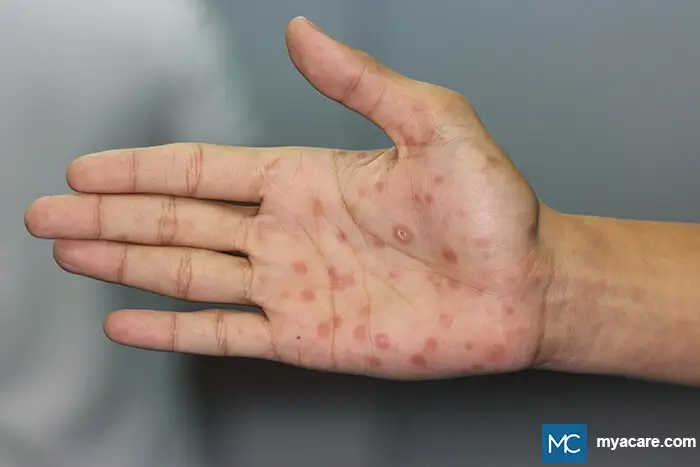
One of the most recognizable and distinctive features of secondary syphilis is the non-itchy rash that can appear on the trunk, limbs, and, notably, on the palms of the hands and soles of the feet, a location uncommon for most other rashes. The rash may be reddish-brown or copper-colored, flat or raised, and it may fade and reappear.
Additionally, some individuals develop mucous patches in the mouth, throat, or genital areas. Condylomata lata, broad, moist, and wart-like lesions, can appear in warm, moist areas, such as the perineum or under the breasts. These lesions are highly infectious.
Other Possible Findings
In some cases, more severe manifestations occur:
- Patchy hair loss, often described as “moth-eaten” alopecia
- Hepatosplenomegaly (liver and spleen enlargement)
- Meningitis, arthritis, glomerulonephritis, and syphilitic hepatitis
These symptoms highlight how secondary syphilis can affect multiple organ systems and mimic other conditions, reinforcing the importance of timely testing and treatment.
Complications
Neurosyphilis and Ocular Syphilis
Two serious complications, neurosyphilis (infection of the central nervous system) and ocular syphilis (involvement of the eyes), can occur at the secondary stage; however, this could happen at any stage. In fact, neurological symptoms such as headache, cranial nerve dysfunction, meningitis, or hearing loss (otosyphilis) may also be present during secondary syphilis. Ocular involvement may result in uveitis, blurred vision, and, if left untreated, potentially permanent vision loss.
If left untreated, secondary syphilis does not resolve the infection; it simply marks a transition into more dangerous stages. Although its symptoms may disappear, the bacteria remain active in the body, posing significant long-term risks.
Progression to Latent and Tertiary Syphilis
Without proper antibiotic treatment, secondary syphilis progresses to the latent stage, which can be divided into early latent (within the first year) and late latent syphilis (after one year). Though asymptomatic, transmission may still occur, especially during early latent syphilis.
Over time, untreated syphilis can advance to tertiary syphilis, a potentially devastating stage that may emerge years, even decades, after the initial infection. Tertiary syphilis can cause:
- Cardiovascular damage, including aortic aneurysms and valvular disease
- Neurological complications, including general paresis and tabes dorsalis
- Bone and joint damage
- Gummatous lesions, which are destructive soft tissue masses
This underscores the value of seeking early care, as untreated infections can lead to complications despite apparent symptom resolution.
Diagnosis
Clinical Evaluation
Diagnosing secondary syphilis starts with a thorough clinical evaluation. Physicians often suspect syphilis based on the characteristic rash, especially when it involves the palms and soles, along with systemic signs like lymphadenopathy, mucosal lesions, and patchy hair loss. However, this stage is notoriously difficult to diagnose due to its wide range of symptoms.
Why Is Secondary Syphilis Called the “Great Imitator”?
Secondary syphilis has earned the nickname “The Great Imitator” because its symptoms mimic a variety of other medical conditions. Its non-specific nature, variable presentation, and tendency to self-resolve without treatment can mislead clinicians and patients alike, resulting in dangerous delays in diagnosis.
It may be mistaken for:
- Pityriasis rosea, which also causes a diffuse trunk rash with a herald patch
- Guttate psoriasis, due to scaly papules on the trunk and limbs
- Ringworm (tinea corporis), because of round, reddish plaques
- Measles or chickenpox, in cases where vesicular eruptions are present
- Hand, foot, and mouth disease, due to palm and sole involvement
- HPV genital warts, which may resemble condylomata lata, though HPV warts are usually firmer and not moist
- Disseminated gonorrhea, especially when there are systemic symptoms and joint pain
Recognizing these overlaps is essential for clinicians to consider syphilis in the differential diagnosis, especially in sexually active individuals.
Serological Testing
To confirm the diagnosis, blood tests are essential and fall into two categories:
- Non-treponemal tests:
- VDRL (Venereal Disease Research Laboratory test)
- RPR (Rapid Plasma Reagin test)
These are used for initial screening and for monitoring treatment response, as their titers decline after successful therapy.
- Treponemal tests:
- FTA-ABS (Fluorescent Treponemal Antibody Absorption)
- TPPA (Treponema pallidum Particle Agglutination test)
These are confirmatory and generally remain positive for life, even after treatment
Additionally, testing for HIV and other STIs is strongly recommended, as co-infection is common and may alter disease progression or presentation.
Can Syphilis Become Non-Reactive?
In rare cases, particularly in late latent syphilis or tertiary syphilis, non-treponemal tests may become non-reactive due to very low antibody levels, making diagnosis more difficult. However, treponemal tests usually remain positive and are critical for retrospective diagnosis.
Treatment
First-Line Treatment
The standard treatment for secondary syphilis is:
- A single intramuscular injection of Benzathine penicillin G (2.4 million units).
This is effective for uncomplicated early syphilis, including primary, secondary, and early latent stages.
Alternatives for Penicillin-Allergic Patients
For patients with a penicillin allergy, oral options include:
- Doxycycline (100 mg twice daily for 14 days)
- Tetracycline or Ceftriaxone may also be used in select cases.
However, penicillin desensitization is preferred in pregnancy or if neurosyphilis is suspected.
Treatment During Pregnancy
Penicillin is the only recommended treatment during pregnancy. Alternative antibiotics are not effective in preventing congenital syphilis. If the patient is allergic, penicillin desensitization followed by treatment is essential.
Jarisch-Herxheimer Reaction
After starting antibiotic therapy, some patients experience a Jarisch-Herxheimer reaction, an acute, flu-like illness with fever, chills, headache, muscle pain, and worsening of existing lesions. This is a reaction to the rapid killing of spirochetes and not an allergic response. It usually resolves within 24 hours.
Follow-Up and Monitoring
Patients must be monitored over time, typically using RPR titers. A fourfold drop in titer within 6 to 12 months indicates successful treatment. Lack of response may suggest:
- Reinfection
- Inadequate treatment
- HIV co-infection
Routine follow-ups are essential to ensure the infection is fully resolved and to prevent progression or transmission.
Prognosis
Secondary syphilis is curable, and with timely antibiotic treatment, usually a single intramuscular injection of benzathine penicillin G, the vast majority of patients experience complete recovery. Secondary syphilis symptoms typically resolve within a few weeks of treatment, although some may notice improvement within days.
How Long Does Secondary Syphilis Last?
If left untreated, secondary syphilis can last anywhere from a few weeks to several months. Symptoms may come and go, often resolving on their own, which can create a false sense of recovery. However, spontaneous resolution of symptoms does not mean the infection is cured; the bacterium Treponema pallidum continues to live in the body, progressing to the latent stage and potentially causing serious complications years later.
Prevention and Public Health Perspective
Safe Sex Practices
The most effective way to prevent syphilis, including secondary syphilis, is through safe sex practices, such as:
- Ensuring consistent and accurate use of condoms and dental dams
- Reducing the number of sexual partners
- Routine STI screening, especially for individuals at higher risk
Partner Notification and Treatment
Anyone diagnosed with syphilis should inform all sexual partners, generally from the past 3 to 6 months (or longer, depending on the stage), so they can be tested and treated promptly. Notifying partners helps limit the spread of infection and supports timely treatment.
Public health departments often assist with confidential partner notification and offer resources for testing and treatment.
Role of Healthcare Providers
Healthcare professionals play a key role in:
- Early identification of syphilis through clinical vigilance and appropriate testing
- Counseling patients on the risks, treatment, and prevention strategies
- Reporting syphilis cases to public health authorities, which is mandatory in many countries, to track outbreaks and coordinate public health interventions
Increased awareness, accessible testing, and timely treatment are essential tools in reducing the global burden of syphilis and preventing its severe long-term consequences.
To search for the best Dermatology Healthcare Providers in Croatia, Germany, Greece, India, Malaysia, Singapore, Slovakia, Spain, Thailand, Turkey, the UAE, UK, the USA, please use the Mya Care search engine.
The Mya Care Editorial Team comprises medical doctors and qualified professionals with a background in healthcare, dedicated to delivering trustworthy, evidence-based health content.
Our team draws on authoritative sources, including systematic reviews published in top-tier medical journals, the latest academic and professional books by renowned experts, and official guidelines from authoritative global health organizations. This rigorous process ensures every article reflects current medical standards and is regularly updated to include the latest healthcare insights.

Dr. Sony Sherpa completed her MBBS at Guangzhou Medical University, China. She is a resident doctor, researcher, and medical writer who believes in the importance of accessible, quality healthcare for everyone. Her work in the healthcare field is focused on improving the well-being of individuals and communities, ensuring they receive the necessary care and support for a healthy and fulfilling life.

Dr. Asif Baliyan is a doctor and clinical researcher with over a decade of experience in evidence-based diagnostic medicine. A Consultant at a tertiary care hospital in New Delhi, he also serves as a medical reviewer, ensuring healthcare content remains accurate, ethical, and aligned with current clinical guidelines.
References:
Featured Blogs

Medically Induced Coma: What It Is, How It Works, Who Benefits, and Recovery Outcomes