
Squamous Cell Carcinoma Overview: Symptoms, Diagnosis, and Care
Medically Reviewed by Dr. Sony Sherpa, (MBBS) - September 29, 2025
Squamous cell carcinoma (SCC), the second most common skin cancer after basal cell carcinoma (BCC), is classified within the broader group of non-melanoma skin cancers.
Its high prevalence is largely due to cumulative ultraviolet (UV) exposure over time, particularly in individuals with fair skin, as well as increased life expectancy and awareness around skin cancer screening.
A key early form of SCC is Bowen’s disease, also known as squamous cell carcinoma in situ, which remains confined to the epidermis. If left untreated, Bowen’s disease can evolve into invasive SCC. With squamous cell carcinoma making up about 20% of all non-melanoma skin cancers, public health efforts continue to emphasize sun protection, early recognition, and timely management.
What Is Squamous Cell Carcinoma?
Squamous cell carcinoma is a type of cancer that develops from squamous cells, the flat cells lining the outer part of the skin (epidermis) and various internal organs, including the throat, lungs, esophagus, and cervix. In the skin, it typically arises on sun-exposed areas, but it can also affect mucous membranes and internal structures.
Growth and Spread
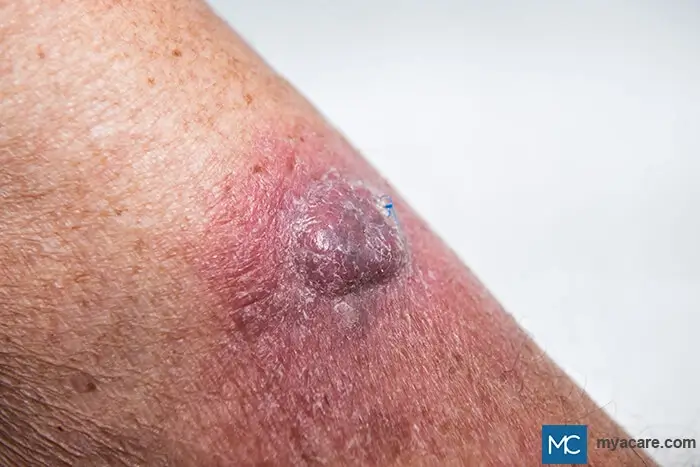
SCC often begins as a rough, scaly patch, raised bump, or non-healing sore. Without treatment, it may extend deeper into the skin and nearby tissues. Unlike basal cell carcinoma, SCC has a greater tendency to invade local structures and, in advanced cases, spread (metastasize) to lymph nodes, making early detection critical. In very rare cases, it may even spread to distant organs such as the lungs or brain.
The rate of SCC spread can vary. Poorly or moderately differentiated tumors, where cells appear more abnormal under the microscope, generally grow and spread faster than well-differentiated types. Moderately differentiated SCC is considered more serious because it demonstrates a greater risk of local invasion and lymphatic spread. However, even in these cases, early diagnosis can significantly improve prognosis.
Stages of Squamous Cell Carcinoma
Staging of SCC takes into account the tumor’s size, how deeply it has invaded, and its spread to lymph nodes or distant locations:
- Stage 0 (Carcinoma in situ/Bowen’s disease): Cancer is confined to the top layer of the skin.
- Stage I: A tumor 2 cm or smaller that remains limited to the skin, without lymph node or deep tissue involvement. This is considered an early and highly treatable stage.
- Stage II: Tumor that is larger than 2 cm but still has no lymph node involvement.
- Stage III: The spread of the cancer involves nearby lymph nodes and may also reach tissues such as bone or cartilage.
- Stage IV: Advanced cancer with distant metastasis (lungs, brain, etc.).
Invasive squamous cell carcinoma refers to cancer that has penetrated below the epidermis into the deeper dermis or even deeper structures such as fat, muscle, or bone. Tumors are classified as Stage I if they are small (≤2 cm) and without high-risk features. They are classified as Stage II if they are larger than 2 cm but smaller than 4 cm. Depth is an important factor; tumors deeper than 2 mm or involving perineural invasion carry higher risks for recurrence or metastasis.
Body Areas Affected
This cancer affects the skin, especially sun-exposed areas such as the scalp, ears, lips, hands, and legs. It may present as a red, scaly lesion, ulcer, or raised growth that bleeds or crusts.
In addition to the skin, SCC can arise in different parts of the body wherever squamous cells are present. It may also develop in mucosal sites such as the mouth, throat, or cervix; however, when occurring in the skin, it is referred to as cutaneous squamous cell carcinoma (cSCC). Unlike mucosal SCCs, which are often linked to smoking, alcohol, or HPV infection, the main risk factors for cSCC include long-term sun exposure, fair skin, advancing age, immunosuppression, and chronic skin injury.
Causes and Risk Factors
SCC mainly arises from cumulative DNA damage in the skin’s squamous cells, causing abnormal cell growth and tumor formation. The most common and well-established cause is ultraviolet (UV) radiation exposure, particularly from the sun. Repeated or intense sun exposure damages the DNA in skin cells over time, eventually leading to mutations that can result in cancer. Artificial sources of UV radiation, such as tanning beds, are equally harmful and significantly increase the risk of developing SCC, especially in younger individuals who use them frequently.
Is Squamous Cell Carcinoma Hereditary?
SCC is not typically considered a hereditary cancer, but genetic factors may play a role in individual susceptibility. People with a family history of skin cancer or inherited conditions that impair DNA repair, such as xeroderma pigmentosum, are at increased risk. However, lifestyle and environmental exposures generally have a far greater influence than heredity in most SCC cases.
Other Risk Factors
Beyond UV exposure and genetics, several other factors can increase the likelihood of developing SCC:
- Fair Skin Type: Those with fair skin, red or blond hair, and blue or green eyes have been shown to lack sufficient natural melanin to shield against UV rays, making them more vulnerable.
- Age: The risk of SCC increases with age due to prolonged cumulative sun exposure.
- History of Sunburns: Severe sunburns, especially in childhood or adolescence, can cause long-term skin damage and raise the risk later in life.
- History of Skin Cancer: A history of any type of skin cancer, including basal cell carcinoma or melanoma, elevates the risk of developing SCC.
- Actinic Keratoses (AKs): These are rough, scaly patches of sun-damaged skin that are considered precancerous. A small percentage can progress to SCC if left untreated.
- Weakened Immune System: Immunocompromised individuals, including organ transplant recipients and those with HIV/AIDS, face a much higher risk of developing aggressive SCC.
- Chronic Inflammatory Skin Conditions: Long-standing wounds, burns, or inflammatory disorders like lupus or lichen planus can increase SCC risk, especially when the skin undergoes repeated damage and repair.
- Exposure to Certain Chemicals: Prolonged contact with carcinogens such as arsenic, coal tar, and industrial solvents can elevate the risk.
- Radiation Exposure: Those who have undergone radiation for other cancers may be at risk of developing SCC in the treated areas.
Symptoms
Squamous cell carcinoma can present in various ways, but it typically appears as a rough, scaly, red patch or sore that does not heal or that heals and then reopens. These lesions often occur on sun-exposed areas such as the face, ears, neck, scalp, hands, and arms. Additional hallmark features include:
- Wart-like growths with a raised surface
- Crusting or bleeding, particularly with minor trauma
- Ulceration, especially in more advanced stages
- Thickened or raised skin, which may feel tender or painful to the touch
- Lesions that grow quickly or change in appearance over a few weeks to months
What Does Early-Stage SCC Look Like?
Early-stage squamous cell carcinoma may resemble a persistent, scaly patch or small, elevated bump that may be pink, red, or flesh-colored. It often resembles a persistent rash, sore, or pimple that won’t go away. Unlike benign skin issues, early SCC tends to enlarge slowly and may become tender, itchy, or bleed without significant provocation. Detecting lesions at this stage offers the highest chance of successful treatment.
Evolution of Lesions
SCC often evolves gradually. What starts as a precancerous lesion, such as an actinic keratosis (AK), can develop into SCC if left untreated. Over time, lesions may:
- Increase in size and thickness
- Develop a central ulcer or crust
- Begin to invade deeper layers of skin or spread to adjacent structures
- In rare cases, metastasize to nearby lymph nodes or distant organs
Early diagnosis and treatment rely on promptly recognizing and evaluating unusual skin changes.
Diagnosis
Accurate diagnosis of squamous cell carcinoma involves a clinical evaluation by a dermatologist and a confirmatory skin biopsy.
Clinical Evaluation
A dermatologist will begin with a visual examination of the skin and a detailed medical history, focusing on sun exposure, immune status, personal and family history of skin cancer, and the lesion’s duration and progression.
Skin Biopsy Types
To establish the diagnosis and evaluate both subtype and depth of invasion, a skin biopsy is performed. Common types of biopsy include:
- Shave biopsy: A thin layer is shaved off the top of the lesion; often used for superficial or raised lesions.
- Punch biopsy: A circular tool removes a deeper core of tissue; useful when deeper layers need to be examined.
- Excisional biopsy: The lesion, along with a margin of surrounding tissue, is completely excised; best suited for small lesions where complete removal is possible.
When Further Evaluation Is Required
For high-risk or invasive SCC, further work-up may include:
- Lymph node assessment: Physical examination or ultrasound of regional lymph nodes to check for spread.
- Imaging tests: CT scan, MRI, or PET scan may be used if there are signs of metastasis or invasion into deeper tissues.
- Sentinel lymph node biopsy: In select high-risk cases, to assess microscopic spread.
Differential Diagnosis
Squamous cell carcinoma can resemble other skin conditions, making accurate diagnosis important:
Basal cell carcinoma: This condition is often confused with SCC, but typically appears as a pearly or translucent bump with visible blood vessels and grows more slowly. BCC may ulcerate, but metastasis is rare.
Actinic keratosis: This is a precancerous lesion caused by sun damage. AKs appear as rough, scaly patches and are usually flatter and less aggressive than SCC. However, untreated AKs can evolve into SCC over time.
A biopsy is essential to differentiate between these conditions and guide appropriate treatment.
Treatment of Squamous Cell Carcinoma
Surgical Excision
A standard treatment where the tumor and surrounding margin are cut out. It’s highly effective, especially for small to moderate lesions.
Mohs Micrographic Surgery
Ideal for high-risk or facial SCCs. This precise method removes the cancer layer by layer while preserving healthy tissue. It offers the highest cure rates (~97–99%).
Cryotherapy
Freezes and destroys superficial SCCs using liquid nitrogen. Best for small or early-stage lesions. Simple, but may leave pigment changes.
Topical Medications
Used for early, superficial SCCs or Bowen’s disease. They are non-invasive but require several weeks of treatment.
Radiation Therapy
Used for patients who cannot undergo surgery or when lesions are large, deep, or in sensitive locations. Effective for local control but may need multiple sessions.
Photodynamic Therapy (PDT)
Combines a light-sensitive drug and specific light exposure. Used for very superficial SCCs and often chosen for cosmetic areas.
Curettage and Electrodesiccation (C & E)
Scraping the tumor followed by cauterization. Suitable for small, well-defined SCCs but less effective for deeper or facial tumors.
Systemic Therapy
For unresectable, recurrent, or metastatic cutaneous squamous cell carcinoma, immune checkpoint inhibitors such as cemiplimab and pembrolizumab are standard options. EGFR inhibitors (e.g., cetuximab) or chemotherapy may be used in selected cases, for example, when immunotherapy is contraindicated or not effective.
Prognosis
The prognosis is excellent when SCC is caught early, and cure rates exceed 95%. However, factors such as tumor size, depth, location (e.g., ears, lips), immune status, and aggressive features (like perineural invasion) may lower success rates. Moderate or poorly differentiated SCCs have higher risks of recurrence or spread.
Survival Rate
Localized SCC has a 5-year survival rate of over 95%. For metastatic SCC, the rate drops significantly, but newer treatments are improving outcomes.
Prevention Tips
- Use sunscreen daily (SPF 30+)
- Avoid tanning beds completely
- Wear protective clothing, hats, and sunglasses
- Limit sun exposure from 10 AM to 4 PM
- Do monthly self-skin checks and get annual skin exams by a dermatologist
- Treat precancerous lesions like actinic keratoses early
Diet and Skin Health
While no foods directly worsen SCC, it is best to avoid processed meats, alcohol, and high-sugar foods, which may promote inflammation. A nutrient-rich diet packed with antioxidant sources like fruits, vegetables, and whole grains helps boost skin healing and immunity.
When to See a Doctor
- New or changing moles or lesions
- Sores that do not heal within 3 to 4 weeks
- Itchy, crusted, or bleeding patches
- Any skin lesion that grows, hurts, or feels firm
Frequently Asked Questions (FAQ)
Can SCC occur in areas not exposed to the sun?
Yes. Though sun-exposed areas are most commonly affected, SCC can develop on the genitals, inside the mouth, or in scars, burns, or chronic wounds.
Is squamous cell carcinoma deadly?
Rarely. Most cases are curable if treated early. However, neglected or aggressive SCCs can spread and become life-threatening.
Can squamous cell carcinoma turn into melanoma?
No. SCC and melanoma are distinct cancers with different origins. However, having one type raises your risk of developing another form of skin cancer.
To search for the best Dermatology Healthcare Providers in Croatia, Germany, Greece, India, Malaysia, Singapore, Slovakia, Spain, Thailand, Turkey, the UAE, UK, the USA, please use the Mya Care search engine.
The Mya Care Editorial Team comprises medical doctors and qualified professionals with a background in healthcare, dedicated to delivering trustworthy, evidence-based health content.
Our team draws on authoritative sources, including systematic reviews published in top-tier medical journals, the latest academic and professional books by renowned experts, and official guidelines from authoritative global health organizations. This rigorous process ensures every article reflects current medical standards and is regularly updated to include the latest healthcare insights.
Dr. Sony Sherpa completed her MBBS at Guangzhou Medical University, China. She is a resident doctor, researcher, and medical writer who believes in the importance of accessible, quality healthcare for everyone. Her work in the healthcare field is focused on improving the well-being of individuals and communities, ensuring they receive the necessary care and support for a healthy and fulfilling life.
References:
Featured Blogs

Medically Induced Coma: What It Is, How It Works & Recovery