AI, Machine Learning, and Emerging Trends in Music Therapy
Mechanism & Modalities of Music Therapy
How AI Is Being Used in Music Therapy
Key Takeaways
- Music therapy uses a range of techniques to support emotional, cognitive, neurological, and physical well-being across different age groups and health conditions.
- AI and machine learning are being used to make music therapy more personalized by tailoring music and interventions to an individual's needs, preferences, and responses.
- AI-assisted music therapy is being explored for conditions such as Alzheimer's disease, stroke, autism, chronic pain, and pre-operative anxiety.
- AI is designed to support, not replace, therapists, with privacy, bias, and clinical oversight remaining essential considerations.
- Further research is needed to confirm the effectiveness of AI-driven music therapy in clinical practice and understand its long-term benefits.
Introduction
Although music has been used for healing since ancient times, interest in music as therapy broadened in the 1800s. However, music therapy was only formally established as a clinical profession in the mid-20th century. There has been an increasing interest lately in applying artificial intelligence (AI) and machine learning (ML) to improve personalized music therapy. There are many benefits of music therapy. For instance, music therapy can be used as neurological, emotional, social, and cognitive support for people struggling with agitation, stress, and even pain. Music therapy can also be used for treating anxiety, depression, and dementia. In this article, we will discuss the different types of music therapy that are used and how AI and machine learning are being implemented to personalize and improve music therapy.
Music Therapy: Mechanism, Modalities
A music therapy session may include playing instruments, singing, dancing, listening to music, or writing lyrics, and depends on the type of music therapy performed. Music therapy affects multiple regions of the brain, including the communication, auditory, and sensorimotor regions. Music affects both the right and left hemispheres of the brain. It causes changes in the nerve cells, stimulating the dopaminergic system, which releases dopamine. Dopamine helps the person feel better as it is a reward system of the brain. There are studies that show the benefits of music therapy.
There are several types of music therapy, many of which are particularly helpful for mental health patients. The different music therapy techniques include:
-
Receptive Music Therapy
The person listens to chosen music that the therapist plays; this helps with mood improvement and communication. This type of music therapy also decreases blood pressure and respiration, and helps with pain relief. Music therapy stimulates a part of the brain called the nucleus accumbens, which helps reduce the intensity of pain for those in discomfort. It helps by distracting patients and also by increasing dopamine in the brain.
-
Active/Expressive Music Therapy
This is another type of music therapy, where the person actively takes part in music. They may play an instrument or sing. This is a way to communicate, which is helpful for patients who cannot communicate verbally.
-
Compositional Music Therapy
A person works with a therapist while creating music. This is a way for a person to express their feelings.
-
Melodic Intonation Therapy
This can include tapping and singing. It is used for people with aphasia. It can help improve aphasia and neuroplasticity of the brain. It cannot cure the condition but can improve speaking ability and breathing.
-
Musical Sonification
A person moves part of the body in sync with music. This method can help with stroke rehabilitation.
-
Vibroacoustic Therapy (VAT)
This is a specialized method where a patient sits on a chair and feels low-frequency sound vibrations. It helps with stress relief and relaxation. The method can be used for patients with Parkinson's and Fibromyalgia.
-
Improvisational Music Therapy
This refers to the spontaneous creation of music by an individual. Improvisational music therapy helps give the therapist insight into the person’s emotional state.
-
Re-Creative Music Therapy
This is where a person recreates music alone or as part of a group. This form of music therapy can help with social skills.
-
Neurologic Music Therapy
This therapy uses a research-based approach, including elements of music such as tempo and rhythm, to help treat the brain. This form of therapy is used on patients with autism, Down syndrome, and cerebral palsy. It helps improve gait, cognition, and neuroplasticity.
-
Guided Imagery and Music
The therapist selects music that allows patients to make associations or remember events. This is a method for bringing unconscious thoughts to the surface, allowing the therapist and patient to explore them. This can help patients who are in pain, and it can help with stress management.
-
Rhythm and Music-Based Intervention
Patients dance to music, walk in time with a rhythmic beat, or play instruments rhythmically. It is used to help people with Parkinson’s improve their gait and movement ability. However, further research is needed on how it influences dopamine-related brain activity.
-
Music Glove
The patient wears a special glove and performs grip and pinch movements in time with music. It is designed to help motor control. It can help during recovery after a stroke.
-
Group Music Therapy
This is therapy done in a group setting. It helps improve social interactions and may help with mood and expression. It can help those with brain injuries and substance abuse.
-
Community Music Therapy
This is the music therapy that connects the community and the person.
-
Nordoff-Robbins Music Therapy
This is a form of music therapy designed to help individuals with disabilities. It helps build confidence and aids communication skills.
How AI Is Being Used in Music Therapy?
There has been a rapid development in the use of AI in music therapy. AI music can complement and enhance traditional music therapy. A patient could visualize emotions in music with artificial intelligence by analyzing different components of music, such as the tempo and melody.
It can be difficult to make music therapy individualized to suit specific patients. This is where AI can help. Some AI algorithms, such as a long short-term memory network (LSTM), can learn from pre-existing music and generate music to suit individuals’ needs. AI, using machine learning, can help in this way with music selection.
AI-generated playlists can be produced based on a patient’s physiology. For instance, the patient’s mood, brain activity, or heart rate can be considered when using AI to create a music list. AI music can be designed to respond to both neural and emotional cues. Some tech companies use AI to develop personalized playlists that help soothe people.
AI music therapy can also include brain-computer interfaces (BCIs), generative music algorithms, and deep learning models. Machine learning (ML) models can be used to predict therapeutic responses to different genres and rhythms of music. This can further guide the development of AI music for individuals. Music therapy offers notable benefits for older adults, with evidence suggesting that it can help improve behavioral outcomes in individuals with dementia. In Japan, researchers have been developing and evaluating the use of an AI music therapist to support elderly people with dementia. It has also been associated with improvements in attention and reduction in anxiety in older adults.
Practical AI Applications
AI-music using machine learning models can be developed using patients’ preferences. Important factors in such models are the person’s sex and preferred music genre.
AI-music can be used for different applications.
-
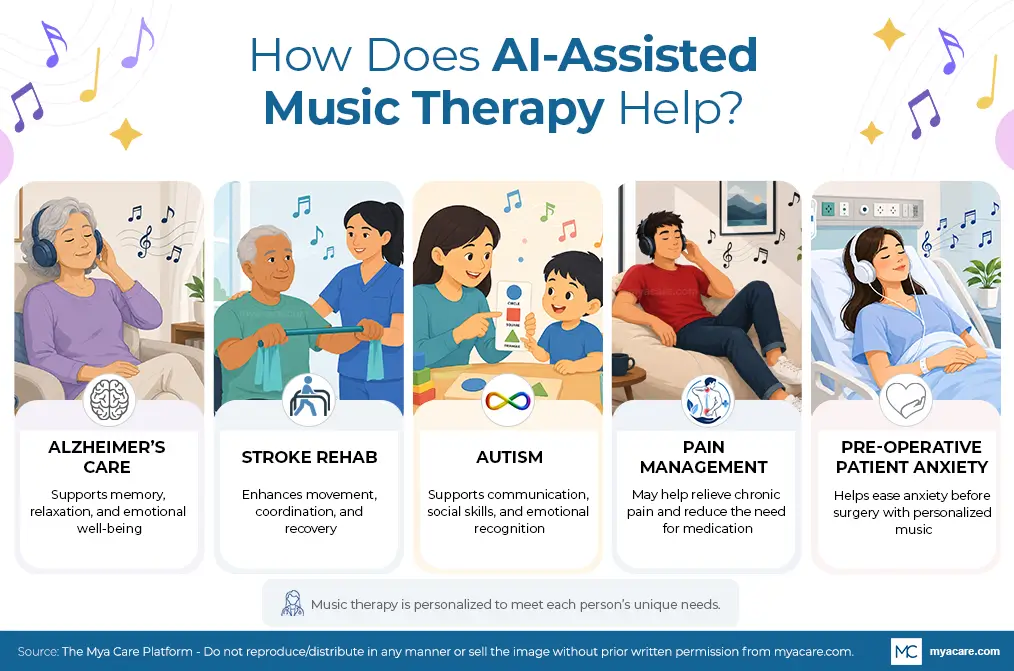
Alzheimer's Care
AI music therapy for seniors with Alzheimer’s can help with memory recall and help calm the person down. Research on music therapy and Alzheimer's has shown improvements in patients’ levels of depression and anxiety.
-
Stroke Rehab
There is evidence-based research indicating that music therapy helps with motor sensations and coordination. Music therapy helps with movement in stroke patients, particularly if rhythmic auditory stimulation (RAS) is used. Motor coordination training through AI music will likely be beneficial. An AI system has been developed where patients can write their own song lyrics. The idea is that this could help stroke patients and others during recovery.
-
Autism
Individuals with autism have problems recognizing emotions in others, making social interactions challenging. AI music therapy can help those with emotion recognition training, fine motor control, and turn-taking. Research suggests that music therapy for autism spectrum disorder helps with language and social skills. More research should be done on music therapy for autism.
-
Pain Management
Music therapy and neurotechnology can help patients with chronic pain. This form of therapy can help reduce the need for potentially addictive medications. The use of AI along with music therapy may maximize the benefits. More studies need to be done on music therapy and pain management.
-
Pre-operative Patient Anxiety
Specific types of music can help alleviate anxiety in patients ready for surgery. Music without singing seemed to be the better option for this. Digital-based music therapy has proven helpful in treating anxiety.
Limitations, Drawbacks, and Ethical Considerations
There may also be bias in how algorithms are designed, which may then not be suitable for patients. Further, people’s perception of the music therapy may be biased if they know it is AI-generated. There are challenges with the AI methods, for instance, designing an AI-feedback method that responds fast enough to avoid patient discomfort.
There are ethical concerns associated with music therapy. Therapists may be concerned about losing their place to AI. Optimally, therapists should be present during a session of AI music to avoid misinterpretation. Informed consent is also essential, as is patient confidentiality and data security.
Risks and Contraindications of Music Therapy
Therapy outcomes are not always as expected. In some individuals, music therapy may trigger emotional distress, strain in interpersonal dynamics, or physical discomfort, highlighting the need for a personalized approach. Repetitive or overly loud/competing sounds can lead to sensory overload, contributing to stress in vulnerable patients. There is also a chance that patients asked to participate actively may feel embarrassed, for example, when singing.
Conclusion
Music therapy is not only for seniors. AI-driven music theory has a place in treating various conditions for all ages. It has emotional and psychological therapeutic benefits.
AI can be used to augment rather than replace music therapy. AI-powered therapies can be advantageous with music therapies because they can be customized to suit an individual.
Additional AI-music therapy research is needed to evaluate how effective it is in the real world, especially in clinical settings compared with consumer settings. More research is needed on AI-driven music therapy and its benefits.
FAQ
Can music therapy help seizure patients?
Yes, but care needs to be taken because although music can help some epileptic patients, in rare cases (musicogenic epilepsy), specific music can trigger seizures. More research is needed.
Can music therapy help with migraine?
Yes. Music therapy can be used for pain management since it decreases the severity of pain in a migraine attack.
Is music therapy a helpful ADHD treatment?
Yes, ADHD music therapy can help with the main symptoms of the condition. More research is needed on music therapy for ADHD.
Can music therapy help psychosis?
Yes, it may help people who have psychotic episodes. However, more research is needed on this.
How does music therapy help schizophrenia?
Music therapy may help alleviate some symptoms of schizophrenia, particularly symptoms such as low motivation and social withdrawal, though its underlying neural mechanism is unknown. More research is needed on how music therapy can help patients with schizophrenia.
Can music therapy help post-traumatic stress disorder?
There is some empirical evidence that music therapy can help post-traumatic stress disorder. Music therapy can help with trauma.
Are the effects of music therapy permanent?
Music therapy is not scientifically proven to have permanent results, although it may have a lasting effect in helping autistic patients to express themselves.
To search for the best doctors and healthcare providers worldwide, please use the Mya Care search engine.
Dr. Rae Osborn has a Ph.D. in Biology from the University of Texas at Arlington. She was a tenured Associate Professor of Biology at Northwestern State University, where she taught many courses to Pre-nursing and Pre-medical students. She has written extensively on medical conditions and healthy lifestyle topics, including nutrition. She is from South Africa but lived and taught in the United States for 18 years.
References:
Featured Blogs

Medically Induced Coma: What It Is, How It Works & Recovery