
MR-Linac: MRI-Guided Precision Radiotherapy for Prostate Cancer

MR-Linac combines MRI with a linear accelerator to deliver highly precise radiation therapy for prostate cancer. Real-time imaging and adaptive treatment planning allow radiation to be tailored to daily anatomical changes, potentially reducing radiation exposure to nearby healthy tissues while maintaining effective cancer treatment in selected patients.
Introduction
Worldwide, prostate cancer is the second leading cancer diagnosis among men. In 2024, an estimated 1.55 million new cases were reported globally, and this number is projected to increase to approximately 2.4 million new cases annually by 2040, primarily due to population growth and aging.
In the United States, prostate cancer incidence has risen by approximately 3% per year since 2014, with even steeper annual increases of 4.6%–4.8% for regional- and distant-stage disease. Researchers suggest this trend is partly related to reduced prostate-specific antigen (PSA) screening following changes in screening recommendations, although other contributing factors are also likely involved.
Although survival rates are excellent when the disease is detected early, treatment decisions can feel overwhelming because several effective options are available. Depending on the stage and risk category of the cancer, patients may be offered active surveillance, hormone therapy, radiation therapy, surgery, or a combination of these approaches.
Advances in radiation oncology have led to increasingly precise treatments that target cancer while minimizing radiation exposure to nearby healthy tissues. This shift toward personalized, organ-preserving care has been driven by improvements in imaging, treatment planning, and radiation delivery.
For many patients, surgery is not the only curative option. Modern forms of radiation therapy for prostate cancer, including stereotactic body radiotherapy (SBRT), proton therapy, brachytherapy, and MRI-guided radiotherapy, can achieve excellent outcomes in appropriately selected patients.
Among the latest innovations is the MR-Linac, a system that integrates magnetic resonance imaging (MRI) with a linear accelerator (LINAC). Unlike conventional radiotherapy machines, an MR-Linac allows clinicians to visualize the prostate continuously during treatment and adapt radiation delivery to daily anatomical changes. This article explains how MR-Linac works, its advantages and limitations, who may benefit from it, and how it compares with other prostate cancer treatments.
Understanding Prostate Cancer
The prostate is a small gland positioned beneath the bladder that helps produce semen. Prostate cancer develops due to uncontrolled growth of cells in the prostate gland. Most prostate cancers grow slowly, but some are more aggressive and require prompt treatment.
Risk Factors
Various factors increase the risk of developing prostate cancer, including:
- Increasing age, particularly after 50 years
- Family history of prostate cancer
- Hereditary genetic mutations such as BRCA1 or BRCA2
- African ancestry
- Obesity and certain lifestyle factors
Common Symptoms
Early prostate cancer often causes no symptoms. As the disease progresses, symptoms may include:
- Difficulty urinating
- Weak urine stream
- Frequent urination, particularly at night
- Blood in the urine or semen
- Pelvic discomfort
- Bone pain in advanced disease
These symptoms can also occur with non-cancerous prostate conditions, making medical evaluation important.
Why Early Detection Matters
Early diagnosis offers the greatest opportunity for cure. PSA blood testing, digital rectal examination, multiparametric MRI, and prostate biopsy help determine whether cancer is present and how aggressive it is.
Several factors help guide treatment recommendations, including:
- PSA level
- Gleason score (Grade Group)
- Cancer stage (localized, locally advanced, or metastatic)
- Age and overall health
- Patient preferences
These factors help determine whether surgery, radiation therapy, active surveillance, or another treatment is most appropriate.
Why Precision Matters in Prostate Cancer
The prostate is located close to several important structures, including the bladder, rectum, urethra, and nerves involved in erectile function. During treatment, the prostate can also move slightly because of bladder filling, rectal gas, or normal physiological changes.
With conventional radiation therapy, clinicians compensate for this uncertainty by treating a slightly larger area around the prostate. Although effective, this can expose more healthy tissue to radiation.
MRI-guided radiotherapy helps address this challenge by allowing clinicians to see the prostate during treatment and adjust radiation delivery if the gland moves. This improved precision may help reduce radiation exposure to nearby organs while maintaining effective cancer treatment.
What Is MR-Linac?
MR-Linac, or MRI-Linac, stands for Magnetic Resonance Imaging-Guided Linear Accelerator. It combines an MRI scanner with a linear accelerator radiotherapy system in a single machine.
The MRI scanner provides detailed images of the prostate and surrounding organs, while the linear accelerator generates high-energy X-rays that destroy cancer cells by damaging their DNA.
Unlike conventional CT-guided radiotherapy, MRI provides superior soft tissue visualization, which helps to distinguish a tumor from surrounding healthy tissue. This also allows clinicians to distinguish the prostate from the bladder, rectum, seminal vesicles, and other nearby tissues with greater accuracy.
An MR-Linac system typically includes:
- MRI scanner
- Linear accelerator
- Radiofrequency coils
- Adaptive treatment planning software
- Motion management and treatment gating systems
Together, these components allow radiation treatment to be personalized for each session.
Several MR-Linac platforms have been developed over the past decade. Today, the most widely used commercially available system is the Elekta Unity, while earlier systems such as the ViewRay MRIdian remain in use at some treatment centers. Newer platforms are also entering clinical practice.
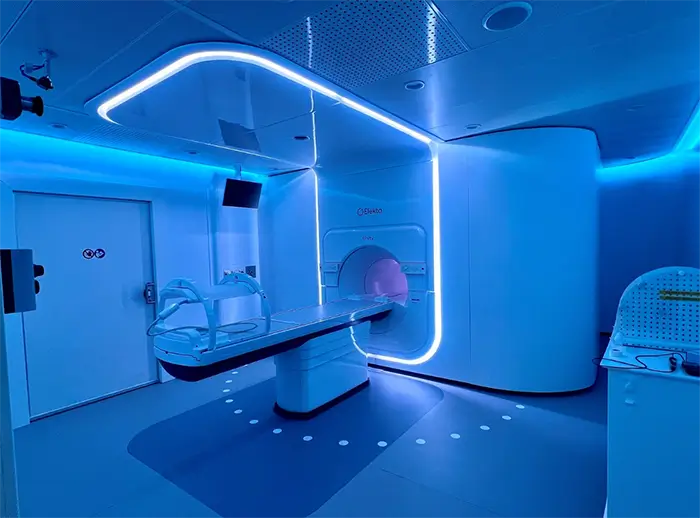
How Does MR-Linac Work?
One of the defining features of MRI-Linac radiotherapy is that treatment is guided by real-time MRI images rather than relying solely on scans obtained before therapy begins.
The MRI is performed before each treatment session on the same machine where the treatment is delivered. The treatment is carried out by a multidisciplinary team led by a radiation oncologist, with support from medical physicists, radiation therapists (or radiographers), and, in many centers, dosimetrists.
Before each treatment session, the patient undergoes a new MRI scan. The radiation oncology team reviews the images to determine whether changes in bladder filling, rectal position, or prostate location require adjustments to the treatment plan.
This process is known as online adaptive radiation therapy (oART).
Depending on the patient's anatomy, clinicians may use:
- Adapt-to-Position (ATP): adjusts the treatment plan if the prostate has shifted position.
- Adapt-to-Shape (ATS): creates a new treatment plan when the shape of the prostate or nearby organs has changed significantly.
During radiation delivery, MRI continuously monitors the prostate. If it moves outside the planned treatment area, the radiotherapy machine automatically pauses radiation delivery — a feature known as automatic treatment gating. Treatment resumes once the prostate returns to the correct position.
This combination of continuous imaging, adaptive planning, and motion management allows radiation to be delivered with exceptional precision.
What Are the Benefits of MR-Linac?
MR-Linac for prostate cancer can offer several potential advantages over conventional linear accelerator radiation therapy as well as surgery.
Non-Invasive Treatment
Unlike surgery, MR-Linac requires no incisions, general anesthesia, or hospital stay. Most patients return home shortly after each treatment session and can continue many normal daily activities.
Improved Precision
MRI provides excellent visualization of soft tissues, allowing clinicians to define the treatment target more accurately than CT imaging alone. Unlike standard CT-guided radiotherapy, MRI-Linac can directly visualize the prostate using superior soft-tissue contrast, potentially reducing the need for implanted fiducial markers and the associated invasive pre-treatment procedure. This also enables smaller treatment margins in carefully selected patients.
The phase III MIRAGE trial demonstrated that MRI-guided SBRT for prostate cancer using 2 mm treatment margins reduced acute urinary and bowel side effects compared with CT-guided SBRT. Historically, conventional CT-guided radiation plans included a 4–5 mm margin around the prostate to compensate for prostate motion, setup uncertainties, and limitations in target localization.
Daily Adaptive Treatment
Each treatment session can be modified to account for daily anatomical changes. This personalized approach helps maintain accurate targeting while minimizing unnecessary radiation to nearby organs.
Protection of Healthy Tissues
Because the bladder, rectum, urethra, and neurovascular bundles can be seen clearly on MRI, clinicians may better limit radiation exposure to these structures. This may reduce certain urinary and bowel side effects, although long-term research is still ongoing.
Shorter Treatment Courses
MR-Linac is well suited for ultra-hypofractionated SBRT, allowing many patients to complete treatment in as few as five sessions instead of several weeks.
Side Effects and Risks of MR-Linac
Although MR-Linac improves treatment precision, side effects remain possible.
Short-term side effects may include:
- Increased urinary frequency
- Urinary urgency
- Mild burning during urination
- Temporary bowel irritation
- Mild fatigue
Most improve within weeks after treatment.
Possible long-term side effects include:
- Persistent urinary symptoms
- Erectile dysfunction
- Rectal bleeding
- Radiation proctitis
- Rare urinary strictures
Overall, early clinical studies suggest MR-guided radiotherapy has an excellent safety profile, but longer follow-up is needed to determine whether it consistently reduces late complications compared with conventional radiotherapy.
Who May Be a Candidate for MR-Linac?
MR-Linac is not appropriate for every patient with prostate cancer, but it can be an excellent option for carefully selected individuals. Treatment decisions should always be made by a multidisciplinary team based on the stage of the cancer, overall health, and patient preferences.
Patients who may benefit include:
- Men with localized, intermediate-risk, and selected high-risk prostate cancer.
- Patients seeking an effective non-surgical alternative to prostatectomy.
- Older adults or those with medical conditions who are less suited for surgery.
- Patients whose tumors are located close to critical structures such as the bladder or rectum, where highly precise radiation delivery may help protect healthy tissue.
- Individuals receiving stereotactic body radiotherapy (SBRT), where accurate targeting is particularly important.
- Patients who prefer shorter treatment schedules with fewer hospital visits.
Who may not be suitable?
MR-Linac may not be appropriate for everyone. Patients with severe claustrophobia may find MRI examinations difficult, although support strategies or mild sedation may help in some cases. Individuals with certain MRI-incompatible metallic implants or older pacemakers may also be unsuitable, although many modern implants are MRI-compatible. Your treatment team will carefully review your medical history before recommending MRI-guided radiotherapy.
What Patients Can Expect
Learning about the treatment process can help ease anxiety and prepare patients for therapy.
Before Treatment
The process typically begins with a consultation with a radiation oncologist to review the diagnosis and discuss whether MR-Linac is appropriate. Planning typically includes a multiparametric MRI and CT simulation scan. Depending on the stage of the cancer, a PSMA PET scan may also be performed to identify the precise extent of disease.
Using these images, the treatment team outlines the prostate, nearby organs, and areas requiring radiation before creating a personalized treatment plan.
During Treatment
On each treatment day, patients lie on the treatment table while a new MRI scan is obtained. This allows the team to evaluate any anatomical changes and, if needed, adapt the treatment plan before radiation is delivered.
Treatment itself is painless. Patients do not feel the radiation beam, although they will hear normal sounds from the MRI scanner and treatment equipment. They must remain as still as possible throughout the session.
Because adaptive planning and MRI guidance require additional imaging and quality checks, each visit usually lasts 30 to 60 minutes, although the actual radiation delivery takes only a small portion of that time.
Many patients complete treatment in five sessions when ultra-hypofractionated SBRT is appropriate, while others may require additional fractions depending on their cancer stage and treatment plan.
After Treatment
Most patients return home immediately after each session and can resume normal daily activities, including work, within a day or two if they feel well.
Short-term urinary or bowel symptoms usually improve over several weeks. Patients are encouraged to stay hydrated, follow dietary advice if recommended, and report any persistent or worsening symptoms to their healthcare team.
PSA Monitoring After Treatment
PSA levels gradually decline after radiation therapy, but this process may take months or even a few years. Unlike surgery, where PSA often falls rapidly, the prostate gland remains in place after radiation and continues to produce small amounts of PSA.
Some patients experience a temporary PSA bounce, a brief rise in PSA followed by a spontaneous decline. Although this can be concerning, it does not necessarily indicate that the cancer has returned. Regular follow-up appointments help distinguish a normal PSA bounce from biochemical recurrence.
MR-Linac vs. Other Prostate Cancer Treatments
Several effective treatments are available for localized prostate cancer. The best choice depends on the characteristics of the cancer and the patient's preferences.
| Feature | MR-Linac | Conventional Radiotherapy | Robotic Prostate Surgery | Proton Therapy | Brachytherapy | CyberKnife SBRT |
| Treatment approach | MRI-guided external beam radiation | CT-guided external beam radiation | Surgical removal of prostate | Proton beam radiation | Radioactive seeds placed inside prostate | Robotic image-guided SBRT |
| Invasive | No | No | Yes | No | Minimally invasive | No |
| Real-time imaging | Yes | Limited | Not applicable | Limited | No | Limited |
| Adaptive planning | Yes | Limited | No | Limited | No | Limited |
| Treatment precision | Excellent | Very good | Surgical precision | Excellent | Excellent | Very good |
| Typical sessions | 5–20 | 20–39 or SBRT | One operation | Variable |
Low dose rate: One procedure High dose rate: 1 or 2 procedures |
Usually 5 |
| Hospital stay | No | No | Usually 1–2 days | No | Often same day | No |
| Recovery | Minimal | Minimal | Several weeks | Minimal | Few days | Minimal |
MR-Linac vs. Proton Therapy
Both MR-Linac and proton therapy are advanced forms of radiation therapy designed to reduce radiation exposure to healthy tissues. Proton therapy uses charged particles with unique dose distribution characteristics, whereas MR-Linac uses high-quality MRI guidance and adaptive planning to improve targeting accuracy throughout treatment. Neither approach has been shown to be universally superior, and the choice depends on individual clinical factors, availability, and specialist recommendation.
MR-Linac vs. CyberKnife
CyberKnife delivers highly precise SBRT using robotic technology and image guidance. However, it does not provide the same level of real-time soft tissue visualization as MRI-guided treatment. MR-Linac's ability to continuously image the prostate and adapt treatment each day may offer advantages in selected patients, although both technologies can achieve excellent cancer control when used appropriately.
Discussions on patient forums often compare CT-guided SBRT with MRI-guided SBRT. Many patients appreciate the additional reassurance provided by continuous MRI visualization, while others note that conventional SBRT remains highly effective when delivered at experienced centers. Ultimately, expertise, careful treatment planning, and appropriate patient selection are at least as important as the technology itself.
Long-Term Outcomes
Early clinical evidence for MR-Linac is highly encouraging. Studies have demonstrated favorable local tumor control and low rates of treatment-related toxicity in patients with localized prostate cancer.
The MIRAGE trial showed that MRI-guided SBRT significantly reduced acute urinary and gastrointestinal side effects compared with CT-guided SBRT. Longer follow-up studies are ongoing to confirm long-term biochemical recurrence-free survival and overall quality-of-life benefits.
Future of MR-Guided Radiotherapy
MRI-Linac technology continues to evolve rapidly.
Artificial intelligence (AI) is expected to factor increasingly in adaptive treatment planning by automating organ contouring, optimizing radiation dose calculations, and reducing overall workflow times.
Researchers are also exploring whether adaptive workflows can safely support even shorter treatment schedules in selected patients. Beyond prostate cancer, MR-Linac is being investigated for cancers of the pancreas, liver, lung, rectum, and other sites where tumor motion presents significant treatment challenges.
Frequently Asked Questions
Does a patient emit radiation after MR-Linac treatment?
No. External beam radiation therapy does not make the body radioactive. Patients can safely spend time with family members, children, and pregnant individuals after treatment.
Can recurrent prostate cancer be treated with MR-Linac?
In selected cases, yes. MRI-guided radiotherapy is being investigated as a tool for carefully planned re-irradiation in patients with locally recurrent prostate cancer. Suitability depends on the location of the recurrence, previous radiation doses, and overall health.
Is MR-Linac better than conventional radiotherapy?
MR-Linac offers important advantages, including real-time MRI guidance, adaptive treatment planning, and automatic motion management. These features may reduce certain side effects in selected patients. However, conventional radiotherapy remains an excellent treatment with proven long-term outcomes, and it continues to be appropriate for many patients. The best choice depends on individual clinical circumstances rather than technology alone.
Can patients with inflammatory bowel disease (IBD) receive MR-Linac treatment?
Inflammatory bowel disease is no longer considered an absolute contraindication to pelvic radiation therapy. Carefully selected patients with Crohn's disease or ulcerative colitis may still be candidates, particularly when modern image-guided techniques help minimize radiation exposure to the bowel. Treatment decisions should be individualized after consultation with both the radiation oncologist and gastroenterologist.

Dr. Walter Armando Vasquez Rivas is a leading Radiation Oncologist at Madrid's Jiménez Díaz Foundation University Hospital, where he has practiced since 2016. Holding specialized Master’s degrees in both Breast and Prostate Cancer, he specializes in advanced clinical therapies such as SBRT, high-dose-rate brachytherapy, and MR-Linac.
As an active clinical researcher, Dr. Vasquez Rivas focuses on trial innovation for prostate cancer, skin cancer, and lymphomas, bridging cutting-edge technology with personalized, evidence-based oncological care.

Jiménez Díaz Foundation University Hospital (Madrid, Spain) is a world-renowned medical institution within the prestigious Quirónsalud Group. A benchmark for clinical excellence since 1935, the hospital is celebrated for its pioneering research, advanced medical education, and compassionate, patient-first care.
Holding the prestigious EFQM 5 Stars 650+ award for management excellence, the center combines cutting-edge technology with top-tier specialists in complex fields like oncology, cardiology, and genetics to deliver highly personalized, world-class treatments for patients worldwide.
References:
Featured Blogs

Medically Induced Coma: What It Is, How It Works & Recovery